

Talking counter terrorism and political violence
Tim Compston, Features Editor at Security News Desk, speaks to Professor Richard English, Director of the Handa Centre for the Study of Terrorism and Political Violence (CSTPV) at the University of St Andrews, to gauge his thoughts on the growing terrorist threat and the lessons, if any, we can take from previous campaigns of violence.
When we meet at St Andrews, Belfast-born Professor English starts our discussion by giving me an insight into what actually sparked his interest in the field of terrorism in the first place: “My initial interest in studying terrorism and political violence came from studying Irish Republican violence. I worked on the IRA, in particular, and wrote about the Northern Ireland conflict and the rival nationalisms in Ireland, more broadly. So I came to this through a particular case study.” He says that over time his focus has broadened out to look at patterns of causation across a wide range of conflicts: “I wanted to understand why political violence is sustained in some cases and not in others and the sorts of things that states do in response to terrorism, whether they are good, bad, or ugly, effective or ineffective,” explains Professor English.
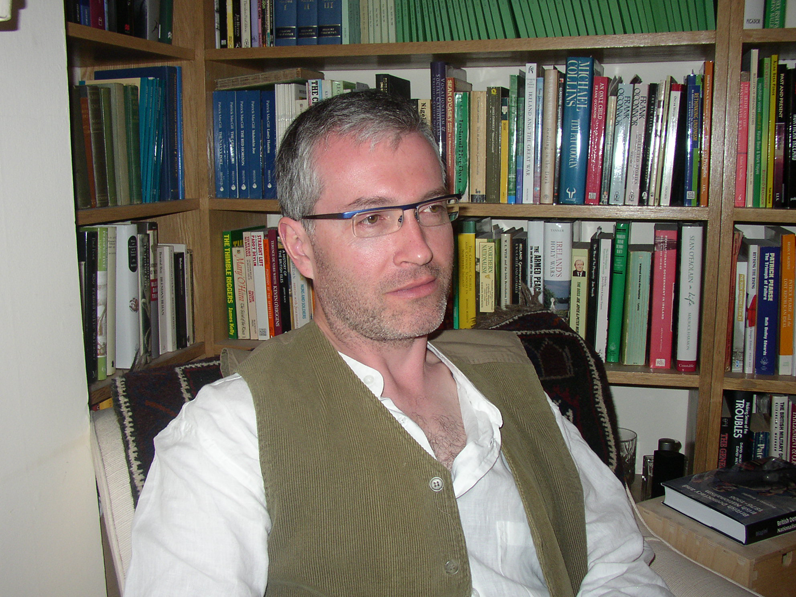 Today, Professor English has firmly established himself as a well-respected authority on the issue of terrorism and is, in fact, the author of several award-winning books on the subject including: ‘Terrorism: How to Respond’ and ‘Armed Struggle: The History of the IRA’. Following 22 years at Queen’s University, Belfast, Professor English joined St Andrews in February 2011, taking up his current position as Director of the Handa Centre for the Study of Terrorism and Political Violence in September the same year: “The job at St. Andrews appealed to me because it would not only focus on specifics but also the broader challenges and I think that terrorism and how to respond to it is one of the global challenges that we face now this century,” explains Professor English.
Research centre
Regarding the work of the Handa Centre itself – which he tells me is the oldest centre of its type in Europe – Professor English says that the focus is very much on research and research-led teaching: “The range of what we study is quite broad, some of it is regionally focused: work on Somalia, work on Northern Ireland and work on the European Union. Some of it is focused on counter terrorism in the context of international organisations: the United Nations, the EU. Some of it is thematic, so we have colleagues who work on the Internet and terrorism and colleagues who work on aspects of particular kinds of techniques of violence, for instance suicide terrorism.”
Jihadist terrorism
Moving on to how the outlook of governments, and the study of terrorism academically, has changed in recent years, Professor English traces a big shift of perspective to the birth of what he refers to as ‘jihadist terrorism’: “In other words, an anti-western Islamically-based variant of a very minority strand within Islamic political thinking.” Professor English goes on to explain that the jihadist strand is associated with trying to produce ‘a kind of domination’ by a certain reading of Islam: “This is evidenced, for instance, in hostility to American-led Western interests and hostility to certain regimes in Muslim countries which these jihadists consider to be illegitimate and apostate.”
Changing priorities
For Professor English things really accelerated, in terms of awareness of the threat of jihadist terrorism, post 2001: “There were of course noises around that in all sorts of settings before but obviously the big watershed was the 9/11 atrocity. After that there was a huge difference. For the first time in its history America began to prioritise terrorism,” he says, “After 9/11 even things which don’t relate to terrorism get cast as terrorism because terrorism becomes a priority.”
Touching on the terrorist threat and radicalisation at home and abroad, Professor English agrees that these scenarios are very different: “I think that, as we saw with Al Qaeda, if you have a group which has lethal intentions towards the west but has a kind of safe haven in Afghanistan that provides a danger. Similarly if you have Syria and Iraq where ISIS can gain a foothold that presents a threat which is not only regionally challenging but may impact on Brussels and Paris and at some stage I fear may do so for London.”
Staying on the home front, Professor English reflects that in Western Europe one factor which certainly comes into play is how the state actually acts, or reacts, to the perceived threat: “All states quite rightly want to protect their citizens and so have to think about the measures to put in place with regards to that. In terms of people becoming disaffected and prone to political violence you will always have some who will. The thing is to turn down the volume on that to make the numbers as small as you possibly can.”
Building a counter narrative
Professor English acknowledges that trying to establishing counter narratives, which might help the situation here, is no easy task: “There are some ways that it has been tried in terms of counter narratives for example people who have gone out as foreign fighters to Syria and Iraq and then become disillusioned afterwards. Sometimes those voices can dissuade people, similarly I think the ways states tell good news stories can be important. So for example in the UK the Mayor of London recently elected is Muslim so it is hard to present the United Kingdom for all of its flaws as a place which is deeply, systematically, anti-Muslim.”
Considering the utility of specific UK Government initiatives, Professor English stresses at the outset that it is very easy for people to criticise government policies however in their defence he reckons that there are no easy answers here: “What I would say is that the record of Contest and Prevent has been mixed. It is true that there have been some important statements and in-roads made.” An approach which Professor English thinks was not particularly wise relates to the linking together of the idea of pursuing Muslim coherence as part of the British community with counter terrorism: “Probably there was a need to separate out the idea of how Muslims were integrated with the idea of preventing some people turning to violence,” concludes Professor English.
Future trends
Asked whether he believes that the situation is likely to improve on the terrorism front in the near term, Professor English says that, frankly, things are going to get worse before they get better. He clarifies that he expects this to happen in two senses: “One is that, partly because of the nature of Western involvement, Iraq is fractured in a way which is very difficult to put back together and Syria has fractured in a way that won’t be put back together. In that sense you have got parts of Iraq and Syria which are effectively going to be unmanageable for a fair period of time and that does give some people the context of ungoverned space in which to plan attacks.”
The second aspect which Professor English brings out, as a reason why we shouldn’t expect a fall-off in terrorism any time soon, is that even though the numbers of people who want to carry out attacks like Paris and Brussels are quite small, there is a disproportionate effect of such attacks: “In the wake of Paris we saw that there was a big reaction in Britain for example. If something like that ever happened in Birmingham or Manchester it would be even bigger. So you get a kind of tit-for-tat escalation of response.”
Looking further ahead, potentially a generation, Professor English feels that there is, in all probability, going to be a process whereby the hopes of people in ISIS turn out not to have been fulfilled, in the same way that the hopes of people in Al Qaeda: “You find a kind of cycle of these things. The difficulty is that these cycles are quite long and people who know about Northern Ireland, for example, appreciate that the Provisional IRA took decades before they decided to change path and go for something less violent and the same for the UDA. So it seems that what we were talking about for things like Al Qaeda, which was founded in the late eighties and still operative in a quite a number of countries, is potentially taking a generation to fizzle out.”
In conclusion
Professor English wraps things up with the thought that, ultimately, countering terrorism is about being able to demonstrate both that violence is not something that is going to produce results and, also, that there are other ways of resolving peoples’ grievances other than using suicide bombing or attacking airplanes: “I think that in that sense it is a long-term process for people to get involved in these kinds of counter arguments, as well as counter terrorism,” he concluded.
[su_button url=”https://www.securitynewsdesk.com/newspaper/” target=”blank” style=”flat” background=”#df2027″ color=”#ffffff” size=”10″ radius=”0″ icon=”icon: arrow-circle-right”]For more stories like this read the Security News Desk Newspaper[/su_button]