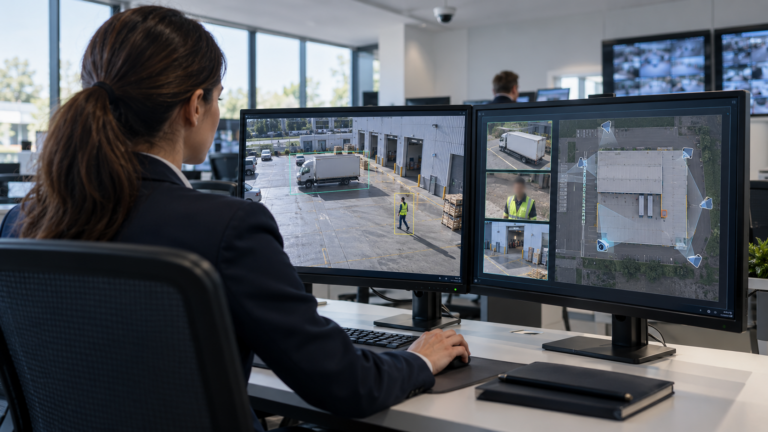


Verkada has published its 2026 State of Cloud Physical Security report, finding a significant difference in artificial intelligence adoption between organisations operating cloud-managed security systems and those relying on traditional on-premise infrastructure.
The research surveyed 2,741 IT and physical security decision-makers across 13 countries, grouped into 10 reporting markets. According to the findings, 80% of organisations are either actively using or piloting AI within physical security, although only 41% have moved beyond the pilot stage. A further 39% remain in testing or evaluation.
The results suggest that AI is becoming established within physical security, but deployment remains uneven and dependent in part on the underlying system architecture.
Cloud users adopt AI faster
Verkada found that 57% of organisations with fully cloud-managed physical security systems are actively using AI, compared with 22% of organisations operating entirely on-premise. Hybrid environments sit between the two, with 38% reporting active AI use.
This means cloud-managed organisations within the survey are using AI at approximately 2.6 times the rate of fully on-premise users. Verkada stresses that the research does not establish that cloud adoption directly causes increased AI use, as factors including organisational size and security budgets may also contribute.
Among organisations already using or testing AI, AI-verified alarm monitoring was reported by 55%, while 53% use AI-generated incident summaries. Real-time detection applications including motion, loitering and line-crossing analytics were used by 47%.
These figures demonstrate how AI adoption is moving beyond conventional video analytics into incident management and alarm verification, potentially reducing the volume of information that operators must assess manually.
Governance remains uneven
The report also identifies a gap between technology deployment and formal governance.
Across all respondents, 41% said they had comprehensive policies governing AI within physical security, while 38% reported measuring a formal financial return from their AI deployments. Among organisations actively using AI, however, 68% reported comprehensive governance, compared with only 28% of those still piloting the technology.
Video data is also increasingly being applied outside traditional security operations. Some 66% of respondents use or plan to use video for workplace safety and compliance, while 58% identified operational efficiency applications.
For security buyers, the findings reinforce the importance of considering infrastructure, governance and measurable business outcomes alongside individual AI features. As adoption accelerates, organisations will need to establish how systems are managed and evaluated rather than simply adding increasingly sophisticated analytics to existing camera estates.