

Installation, operation and expansion: electronic access control has costs attached to every stage of its lifetime. But these costs are not fixed.
Choosing wireless over wired locking can play an important role in reducing energy use — and therefore expenditure.
Cost savings at installation: faster, simpler fitting
Savings begin at the very start. Installation stage is the largest contributor to potential cost saving when businesses choose wireless access control.
In calculations for one costings report, ASSA ABLOY experts examined projected costs for a 100-door installation. Labour savings for those who chose wireless versus wired locks were 82.5%*.
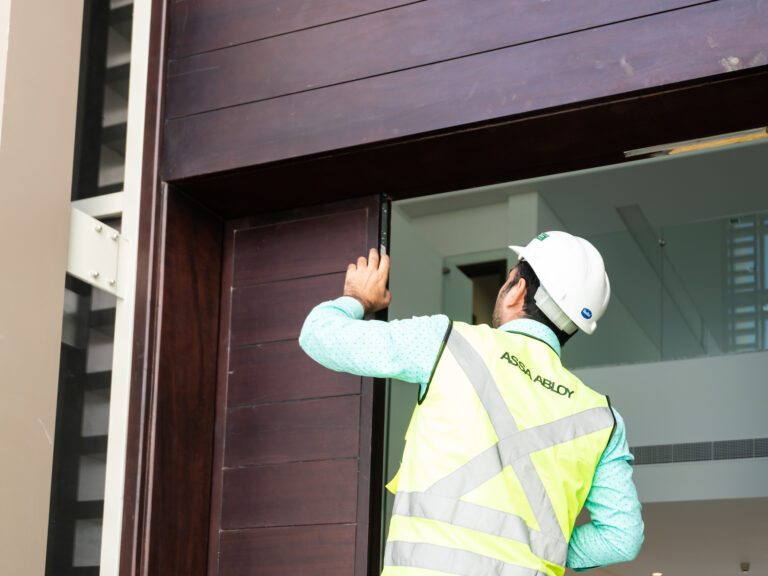
Why? Firstly, because wireless installation is much faster. It is also less intrusive. Most wireless locks require little or no drilling around the door, whereas wired access control needs cabling through and partly around a door — which means specialist electrical installers, too.
By choosing a wireless solution, organizations also upgrade building security without inconveniencing staff or disturbing everyday work routines.
Cost savings during use: less energy, better sustainability performance
In 2017 the Harvard Business Review declared energy efficiency one of the “key levers for business success”**. This opinion may be more true now than ever before.
Between 2021 and 2022, non-household energy prices increased by at least 10% in every EU country except one. In Greece, Romania and Denmark, unit prices for businesses more than doubled***. Wireless, battery-powered devices can help protect against increases and volatility.
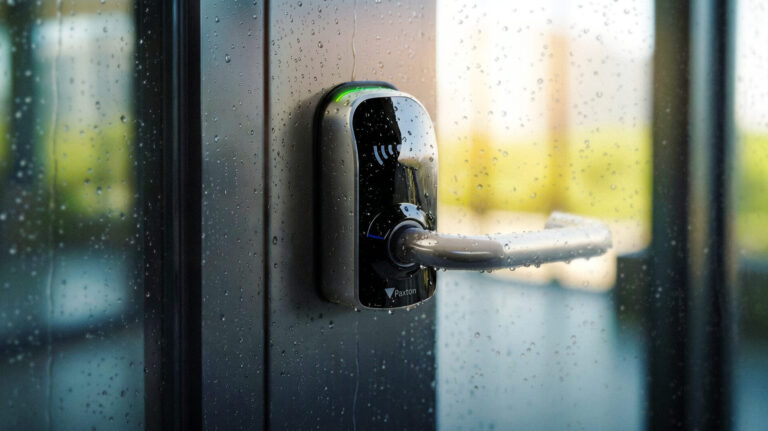
Battery-powered locks use less energy than traditional wired locks, which normally work via magnets connected permanently to electricity. Wireless locks work differently. They only “wake up” when presented with a credential, to make an access decision.
This translates to an additional saving on energy costs: more than 70%*, or thousands of euros over a typical access control solution’s lifetime.
Other related energy and materials costs during use are also lower. In operation, wireless locks only need a change of their standard battery — which may be rechargeable — typically once every two years. No specialist maintenance is required.
Cost-savings from longer life: reuse and space flexibility
Wireless locks also add flexibility — and can reduce costs — when an organization reconfigures or expands their office space.
High-quality, innovative wireless locks like ASSA ABLOY’s Aperio® range can typically be reinstalled at another door without impacting reliability. They move to wherever is convenient.
If a business is rethinking workspace to encourage flexible or hybrid work patterns, for example, cost efficiencies could be significant****. Typical savings on office relocation or expansion are estimated at around 30%* with wireless over wired locking.
Reducing energy use while extending control: University of St Andrews
As home of the renowned St Andrews Prize for the Environment, the University of St Andrews has sustainability at the heart of its ethos. For student accommodation, university managers sought an energy-efficient access control solution which respected and reflected these principles.
A major challenge facing the university was that multiple different standalone access control technologies had been installed piecemeal at student halls over the years. To upgrade the accommodation, university managers sought a more suitable, integrated solution.
They university chose ASSA ABLOY Aperio battery powered electronic escutcheons. Approximately 1,600 doors so far are equipped with electronic access control — without cabling*****.
The Aperio devices integrate fully and work flexibly with both the university’s existing central system and their student ID card. University security managers continue to enjoy the efficiency benefits of monitoring and controlling access from a single point and in real time, including for doors in multiple buildings.
Energy efficiency and more control with Aperio
In comparison to a wired access control solution, Aperio devices offer significant energy efficiency benefits. Devices are wireless, so can be installed with little energy use and no need for wiring to mains electricity. They consume zero energy when idle and run on standard batteries, consuming little power during operation.
Through an entire product life-cycle, Aperio combines reliability and energy efficiency with cost effectiveness. In doing so, Aperio contributes to the university’s sustainability goals.
At the same time, online integration with St Andrews’ central management system has improved access for all users.
“Aperio gives us central management and control,” says Pauline Brown, Associate Chief Information Officer at University of St Andrews, “and contributes to our award-winning track record in energy efficiency.”
To read the full exclusive and other news stories and exclusives, see our latest issue here.
Never miss a story… Follow us on:
 Security Buyer
 @SecurityBuyer
 @Secbuyer
Media Contact
Rebecca Morpeth Spayne,
Editor, Security Portfolio
Tel: +44 (0) 1622 823 922
Email: [email protected]