

 DP World, global marine terminal operator, is constructing the UK’s first new major deep-sea container port this century. The new initiative part of a development that will include the largest logistics park in Europe. The London Gateway terminal is on the north bank of the river Thames at Thurrock in Essex, to the east of London.
CHQ Security Services are acting as security and risk assessment consultants to the project in order to assist DP World in meeting and exceeding the requirements of the International Ship and Port Facility Security Code (ISPS), the maritime sector’s response to 9/11.
The consultancy’s remit has been to ensure that London Gateway benefits from best-of- breed security and safety solutions and that these are combined to optimise performance of the port and facilitate the work of the Home Office UK Border Agency.
CHQ have advised on and implemented equipment across CCTV, perimeter intrusion detection systems (PIDS), access control and wide-area surveillance
A crucial aspect of security at London Gateway has been creation of an ISPS demarcation line within which client and third parties conduct crucial operational activity such as safety & welfare and security reviews. (The ISPS code demands that operators must define a perimeter and have a declared method of monitoring it.)
 CHQ have designed a perimeter intrusion detection system (PIDS) as well as CCTV surveillance strategy for site-wide security and protection of the terminal building.
Mark Rogers is Director of Global Security at DP World. He said: “At tender stage, CHQ Security Services showed a clear grasp of the project and an understanding of what DP World wanted to achieve. Safety, security and a carbon-efficient agenda are uppermost for us but any port will also strive for optimum productivity, something that we owe our clients. CHQ have helped us to achieve balance.”
The London Gateway site covers 600 hectares and works have included movement of 27 million cubic meters of sand to optimise tidal window access for deep-drafted vessels. This has further enhanced the site’s advantages over rival ports.
Kevin Brownell, a director of CHQ who is himself a qualified Port Facility Security Officer, said: “DP World wanted a robust, effective security strategy that would be unobtrusive and in sympathy with both the built and natural environment. Proceeding from an initial requirement of CCTV design, our remit grew and CHQ began consulting with departments including facilities, engineering and health & safety in addition to security.
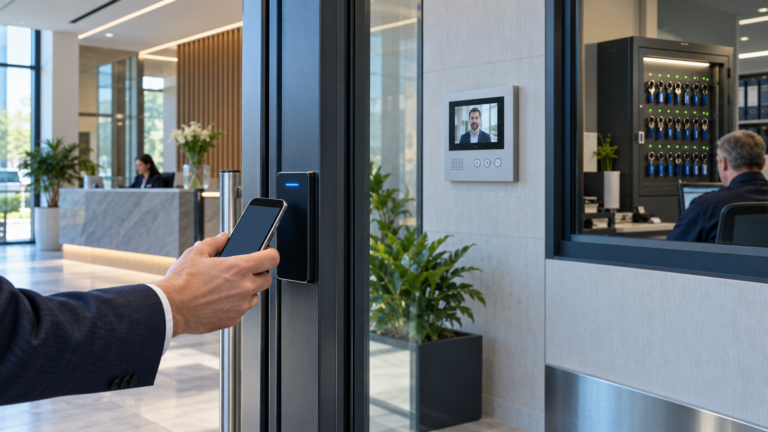
As CHQ’s role in the project grew, the consultancy was able to unify what would have been disparate access control systems. It is a requirement of the ISPS Code that access control should have three tiers according to perceived threat levels.
 Mustering is also a prime health and safety concern at London Gateway. CHQ realised that in the event of an alarm, staff, contractors and visitors would be unlikely to use their badges as they left buildings. However, installation of badge readers located outdoors means that in the event of an emergency, marshals will know who has left the building and, crucially, who remains inside. (Use of smartphone apps will give marshals real-time information.) CHQ not only created an access control system with hierarchical rights management but are now integrating this with DP World’s time and attendance software.
London Gateway will have six berths and is due to open for shipping in the fourth quarter of 2013. It is at the forefront of innovation in the maritime sector and will use automated container handling systems and controls as cargo is transferred to the adjacent logistics park. The proximity of the logistics centre on the same site will reduce the carbon footprint of all parties since ‘empty’ miles for container transport will be minimised. Speed to market will also be dramatically improved.
Arrival of the largest and most sophisticated port cranes in the world at the 2,700 metre long container quay has already created media attention. The cranes weigh 1,848 tons and at 138 metres, are taller than Nelson’s Column. It is expected that London Gateway will create 14,000 new jobs.
For more information visit www.meridianmedia.co.uk.