

AI is redefining smart building security. Micron explores how resilient, edge-ready memory and storage solutions enable real-time analytics, autonomous access, and data-driven safety
Smart buildings are rapidly shifting from passive structures to intelligent, responsive environments. The integration of technologies such as artificial intelligence (AI), edge computing, and IoT is redefining how buildings manage energy, monitor access, and protect occupants. According to industry projections, the global smart building market is expected to grow from $143 billion in 2025 to over $548.5 billion by 2032, exhibiting a CAGR of 21.2%—underscoring a dramatic shift in priorities across commercial, government, and residential infrastructure.
As physical and digital security converge, smart buildings are embedding AI into their core operations. Security cameras are no longer passive observers—they are data-driven agents capable of detecting threats, verifying identities, and enabling energy efficiencies. Yet these capabilities are not driven by AI alone. They depend on fast, resilient, and scalable memory and storage infrastructure to process data at the edge and ensure real-time responsiveness.
For companies developing AI-driven security solutions, system architects, and integrators, the challenge is clear: how to design smart buildings that are not only intelligent—but secure, reliable, and future-proof from the ground up. Memory and storage are no longer peripheral considerations—they are mission-critical.
Memory and Storage Architecture for Intelligent Buildings
As AI capabilities expand within smart buildings, system design must evolve to support the data and computational demands of intelligent, real-time operations. Traditional security architectures, reliant on central servers and DVRs, are being replaced by distributed edge infrastructures. Devices such as smart cameras, biometric readers, and access control panels are no longer simple endpoints—they are AI-powered systems that require both fast memory and durable storage to function reliably at the edge.
Memory plays a crucial role in running inference models directly within devices. Whether executing object detection, facial recognition, or behavioural analytics, these applications require substantial memory bandwidth and low-latency access to data. DRAM technologies such as LPDDR4 and LPDDR5 are increasingly integrated into edge AI devices to support inference workloads. These memory components must be capable of handling model weights, frame buffers from video streams, and intermediate processing data—all while maintaining low power consumption and thermal stability in compact enclosures.
At the same time, storage is needed to house AI models, log high-resolution video footage, and retain access records or environmental metadata. Edge devices often rely on industrial-grade microSD cards for local video recording due to their compact footprint and endurance. For more complex analytics conducted at the edge server level, high-performance NVMe SSDs provide the necessary bandwidth for mixed workloads, including sequential video writing and random data access.
Operational demands in smart building environments require memory and storage solutions to perform consistently over long periods, often in space-constrained locations subject to temperature fluctuation and limited maintenance access. Manufacturers like Micron address these requirements with a portfolio of edge-optimised DRAM, microSD cards, and NVMe SSDs engineered for 24/7 operation, low power usage, and high endurance in mission-critical deployments. These components do more than store data, they support the real-time intelligence that modern building systems depend on.
Hybrid AI Architectures: From Edge to Cloud
While edge AI is crucial for immediate decision-making in smart buildings, most systems rely on a hybrid model that pairs local processing with cloud-based oversight. This combination enables buildings to maintain autonomy during connectivity interruptions while still benefiting from the scalability and centralisation of the cloud.
At the edge, memory enables real-time AI inference within security devices. High-performance DRAM supports the immediate processing of video feeds, biometric inputs, or sensor data without latency bottlenecks. In parallel, local storage captures video footage, logs user interactions, and temporarily retains metadata until it can be reviewed or archived. This ensures continuity in operations such as access control, threat detection, and surveillance, even when cloud access is limited or unavailable.
Cloud platforms, meanwhile, are used for longer-term data archiving, large-scale analytics, and cross-building system coordination. Logs and video clips may be uploaded for compliance, investigations, or future model training. The AI models themselves may also be periodically updated from the cloud, based on evolving threat signatures or operational requirements.
AI’s Expanding Role in Smart Building Security
AI is rapidly reshaping physical security, especially in building environments where traditional access control and CCTV systems once operated independently. By adding layers of intelligence to video and sensor data, AI allows buildings to not only monitor but actively interpret their environments.
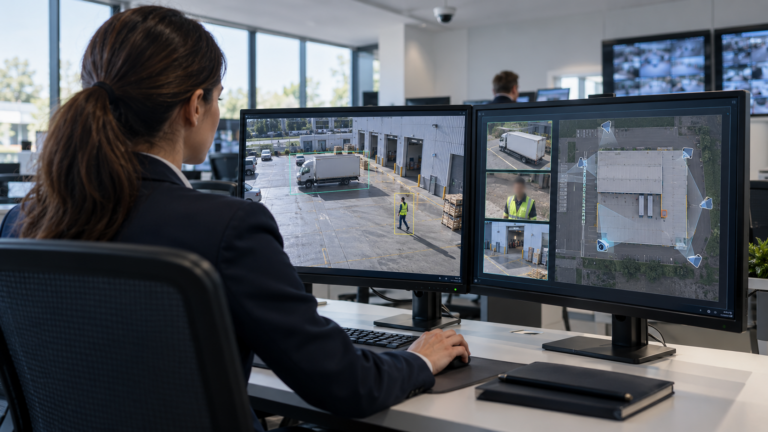
AI-powered video security solutions can detect anomalies, such as loitering, tailgating, or unusual access patterns—and trigger real-time alerts. This represents a move away from passive monitoring toward predictive and autonomous response. In large or multi-site facilities, this means human operators are no longer the first line of incident detection, AI takes that role, flagging only what needs intervention.
At access points, facial recognition and biometric verification provide frictionless identity validation, eliminating the need for keycards or PIN codes. In high-security zones, AI-enabled systems can dynamically enforce access policies based on user roles, time of day, and behavioural cues…