
Written by Richard Mansfield, HEBCoN Deputy Chair and Head of Security at City University London and Darren Chalmers-Stevens, EMEA Director, CriticalArc.
With the upcoming Higher Education Business Continuity Network (HEBCoN) conference seeing members from the higher education industry gather in Leeds on 23-24 October 2014, there’s never been a better time for institutions to look at the latest advancements in cloud technology and the use of smartphones to support emergency management, incident response, and business continuity.
When disaster strikes, planning and preparedness can have a profound impact on a university’s ability to deal with the aftermath. The start of 2014 saw many of the UK’s leading universities threatened or severely affected by the winter storms and floods. This year’s HEBCoN conference will look at some of the lessons learned from flooding and other major incidents at education facilities across the world, and examine how the use of the latest technology can support existing response plans, ensure better outcomes and ensure business continuity.
The immediate response to an incident is critical and the limitations of most existing command and control systems makes it difficult to locate response team members and coordinate a fast, appropriate response, especially if teams are mostly dependent on two-way radio for communication. Emergency Management teams can struggle to share relevant, consistent live information with in-house staff, contractors and third parties including the emergency services, thus hindering the chances of coordinating the best outcome with minimal disruption to university operations.
The ability to geo-target mass communication across dispersed estates can be vital during a serious incident. However, few universities can communicate rapidly with very large groups when mobile networks experience high SMS traffic; those legacy methods are costly and unreliable. Adding to the challenge is the growing international student demographic, prevalence of lone workers, and more students and staff working from home, making it almost impossible for universities to efficiently communicate with every staff member and student.

Cloud technology enabling distributed command and control
With the majority of staff and students along with Emergency Management teams using smartphones, universities are now looking at leveraging the ubiquity of mobile devices together with the latest cloud-based Distributed Command and Control Solutions (DCCS) to support emergency response operations and business continuity. Using a subscription model, cloud services offer forward-thinking universities numerous benefits without the ties and costs of traditional licensed software or owned-infrastructure. The cloud model assumes the vendor takes all responsibility for managing, operating and supporting the computing environment as well as securing the confidentiality and availability of user data. This means universities do not need additional dedicated IT infrastructure such as server capacity and networks or the associated in-house IT resources, enabling rapid implementation in a matter of days. With cloud services, upgrades are also included, along with maintenance and updates to ensure ongoing compliance with regulatory changes.
A coordinated response
Designed to support and extend existing physical security systems, IT infrastructures and human resources, the innovation of DCCS enables more effective incident response without extra capital investment. DCCS extends the reach of first responders by combining a comprehensive situational awareness system for response teams with a smartphone app for students and staff.
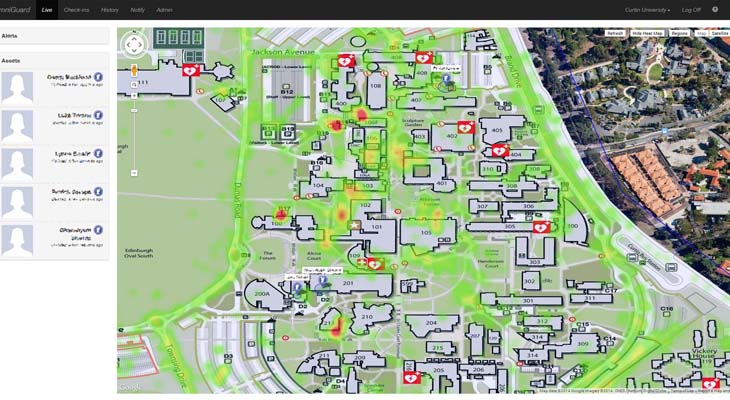
Providing the whole incident response team with real-time situational awareness gives all responders and emergency coordinators visibility of the situation when an alarm is raised, with constant updates as the incident unfolds. Accurate timely information about the type of help needed, identity and location of the person or persons raising an alarm and location of other team members allows responders to optimise their actions for the best possible outcomes.
In addition, a major incident can involve cross functional university staff not only from the Emergency Management team, but human resources and facilities management as well as hundreds of Building Wardens and First Aid volunteers. Supporting a Gold, Silver and Bronze command and control structure also allows effective collaboration across departments as well as with third party agencies including police, ambulance and fire services for effective decision making. The mobile nature of DCCS allows coordinators to direct operations on the ground as well as from the control room, permitting incident controllers to actively participate in response and clean-up operations, which proved particularly challenging after the 2014 UK floods.
Through a more highly coordinated response, universities are better able to defend critical research work as well as physical assets, including buildings and IT infrastructure that is often spread across cities. On a large and dispersed campus, checking every building is going to take time. Since many UK universities operate listed and historic buildings, any subsequent clean up and restoration can take years, seriously impacting student enrolments and the bottom line. A DCCS supports a risk-based priority order, ensuring teams can be directed efficiently to carry out necessary reconnaissance and defensive efforts. In doing so, universities maximise up-time, improve business continuity and shorten time to fully-restored operations, limit damage and minimise corresponding insurance claims.

Communication, communication, communication
The need to mass communicate efficiently both during and after an incident, cannot be underestimated. The use of an app on every staff and student smartphone allows Emergency Management teams to communicate warnings and precautionary measures en-mass in the event of a sudden incident, such as suspect package, power cut or at the more extreme; an active shooter situation, or ahead of predicted hazardous weather conditions. Depending on the threat, such messages can direct recipients to situational report pages for more detailed instructions on how to handle the current situation.
In addition, lone worker check-in and man down features enable Emergency Management teams to locate and protect staff and students working alone, while informing those that may be working at home. After the UK floods of 2014, it was important to get research and learning facilities back up and running as quickly as possible. Emergency planning and disaster recovery plans supported business continuity, yet communicating with students and staff proved cumbersome, leaving confusion as to which parts of universities were fully operational. Today DCCS could alert every staff member and student to the current status quo as soon as they arrive on site, advising on the location of lectures and any continued health and safety risks. At the same time, managers can target messages at specific groups and departments to ensure business as usual is resumed. Plus with comprehensive data capture and incident recording, a DCCS could also support regulatory compliance and reporting, making audit trails available for insurance, forensic, debrief and future team training purposes.
HEBCoN Conference
This year’s HEBCoN conference, headline sponsored by CriticalArc, creators of the revolutionary distributed command and control solution, SafeZone™, is due to take place on 23-24 October 2014 at Weetwood Hall, Leeds. The annual event sees HEBCoN members come together from Higher Education Institutions (HEIs) across the UK and Ireland; committed to sharing and promoting good practice in Business Continuity Management (BCM), risk management and emergency planning.