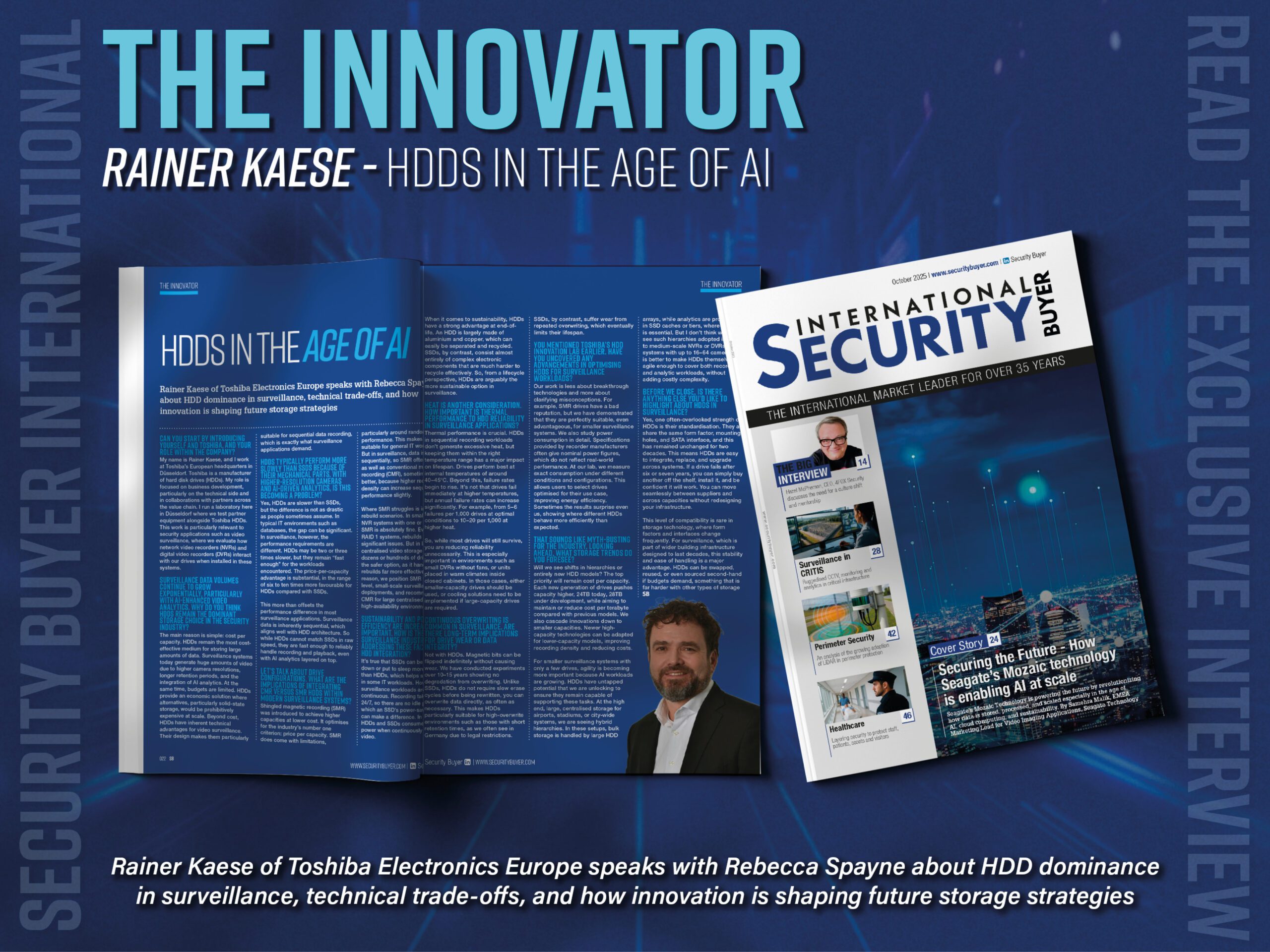

 Rainer Kaese of Toshiba Electronics Europe speaks with Rebecca Spayne about HDD dominance in surveillance, technical trade-offs, and how innovation is shaping future storage strategies
Can you start by introducing yourself and Toshiba, and your role within the company?
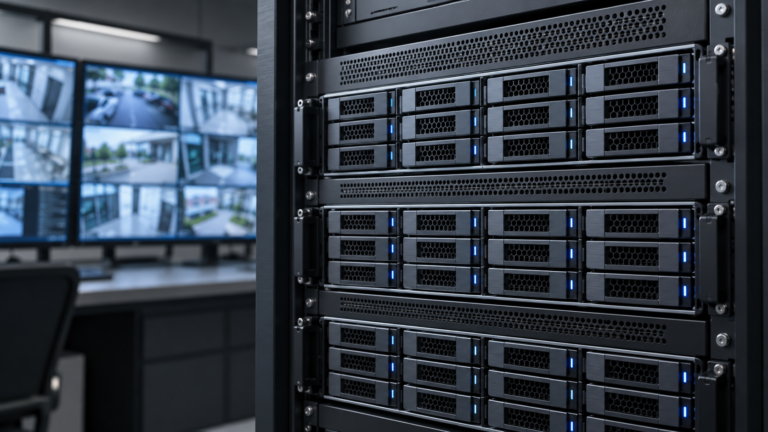
My name is Rainer Kaese, and I work at Toshiba’s European headquarters in Düsseldorf. Toshiba is a manufacturer of hard disk drives (HDDs). My role is focused on business development, particularly on the technical side and in collaborations with partners across the value chain. I run a laboratory here in Düsseldorf where we test partner equipment alongside Toshiba HDDs. This work is particularly relevant to security applications such as video surveillance, where we evaluate how network video recorders (NVRs) and digital video recorders (DVRs) interact with our drives when installed in these systems.
Surveillance data volumes continue to grow exponentially, particularly with AI-enhanced video analytics. Why do you think HDDs remain the dominant storage choice in the security industry?
The main reason is simple: cost per capacity. HDDs remain the most cost-effective medium for storing large amounts of data. Surveillance systems today generate huge amounts of video due to higher camera resolutions, longer retention periods, and the integration of AI analytics. At the same time, budgets are limited. HDDs provide an economic solution where alternatives, particularly solid-state storage, would be prohibitively expensive at scale. Beyond cost, HDDs have inherent technical advantages for video surveillance. Their design makes them particularly suitable for sequential data recording, which is exactly what surveillance applications demand.
HDDs typically perform more slowly than SSDs because of their mechanical parts. With higher-resolution cameras and AI-driven analytics, is this becoming a problem?
Yes, HDDs are slower than SSDs, but the difference is not as drastic as people sometimes assume. In typical IT environments such as databases, the gap can be significant. In surveillance, however, the performance requirements are different. HDDs may be two or three times slower, but they remain “fast enough” for the workloads encountered. The price-per-capacity advantage is substantial, in the range of six to ten times more favourable for HDDs compared with SSDs.
This more than offsets the performance difference in most surveillance applications. Surveillance data is inherently sequential, which aligns well with HDD architecture. So while HDDs cannot match SSDs in raw speed, they are fast enough to reliably handle recording and playback, even with AI analytics layered on top.
Let’s talk about drive configurations. What are the implications of integrating CMR versus SMR HDDs within modern surveillance systems?
Shingled magnetic recording (SMR) was introduced to achieve higher capacities at lower cost. It optimises for the industry’s number one criterion: price per capacity. SMR does come with limitations, particularly around random write performance. This makes it less suitable for general IT workloads. But in surveillance, data is written sequentially, so SMR often works as well as conventional magnetic recording (CMR), sometimes even better, because higher recording density can increase sequential performance slightly.
Where SMR struggles is in RAID rebuild scenarios. In small DVR or NVR systems with one or two drives, SMR is absolutely fine. Even in simple RAID 1 systems, rebuilds do not pose significant issues. But in large centralised video storage arrays with dozens or hundreds of drives, CMR is the safer option, as it handles RAID rebuilds far more effectively. For this reason, we position SMR for entry-level, small-scale surveillance deployments, and recommend CMR for large centralised or high-availability environments.
Sustainability and power efficiency are increasingly important. How is the surveillance industry addressing these factors in HDD integration?
It’s true that SSDs can be powered down or put to sleep more quickly than HDDs, which helps save energy in some IT workloads. However, surveillance workloads are continuous. Recording takes place 24/7, so there are no idle periods in which an SSD’s power-saving modes can make a difference. In practice, HDDs and SSDs consume comparable power when continuously writing video.
When it comes to sustainability, HDDs have a strong advantage at end-of-life. An HDD is largely made of aluminium and copper, which can easily be separated and recycled. SSDs, by contrast, consist almost entirely of complex electronic components that are much harder to recycle effectively. So, from a lifecycle perspective, HDDs are arguably the more sustainable option in surveillance…