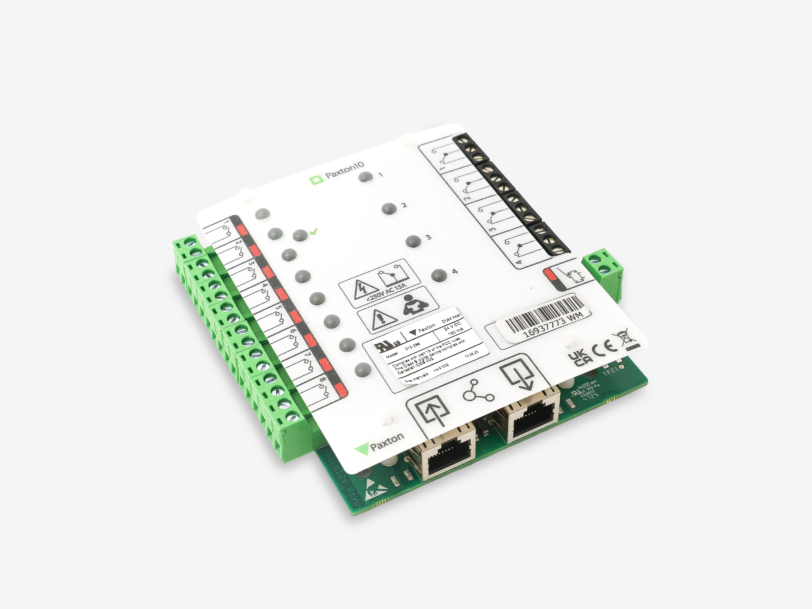

Paxton has detailed a series of updates to its Paxton10 access control and video management platform, including new input and output connectors that allow security events to trigger actions across wider building systems.
The Paxton10 I/O Connectors work with the platform’s existing Triggers and Actions functionality. Events such as a credential being presented, a door opening or an access decision being made can therefore initiate responses involving other connected equipment.
Three connector configurations are available: an I/O Connector providing eight inputs and four outputs, an Input Connector providing 16 inputs and an Output Connector providing eight outputs.
The development further blurs the distinction between access control and wider building automation, particularly for sites where security events need to influence lifts, alarms, lighting or other infrastructure.
Access events trigger wider actions
Paxton says switches, sensors, monitoring points and door contacts can be connected to equipment including heating, air conditioning, lighting, water systems, lifts and alarms.
This creates several potential applications. An access event could activate equipment when an authorised employee enters a particular area, while security events could trigger alarms or other predefined responses.
The Input Connector can also monitor contacts including doors, emergency exits, hatches and technical alarms. Communication between the connector and Paxton10 door controller uses encrypted RS485, while the modules are powered through the controller.
Paxton has accompanied the hardware additions with software improvements. These include new PaxLock commissioning tools, remote server reboot functionality, enhanced user imports and changes intended to make large event backups and restores more reliable.
Multi-site environments have also received enhanced time-zone management so that events and reports reflect the correct local time at each site.
Security platforms move into building operations
Paxton10 combines video and access control within a web-based platform supporting up to 1,000 doors, 1,000 cameras and 50,000 users.
The addition of wider I/O functionality reflects a broader change in enterprise security. Access control platforms increasingly need to exchange information with systems outside the traditional security estate.
For integrators, that creates opportunities to automate processes that previously required separate systems or additional control infrastructure. For end users, however, greater integration also means that access control decisions may have consequences beyond opening a door.
System design therefore needs to consider what happens when a connected component fails, which users are permitted to alter automated actions and how activity is audited.
The latest Paxton10 changes illustrate how access control is becoming an increasingly active component of wider building operations, rather than simply an electronic replacement for mechanical keys.