

A new report from Dedrone by Axon shows how quickly airspace security is becoming a routine part of public safety, enterprise risk management and defence operations, with major changes expected to accelerate through 2026.
Now in its 10th year, the annual report tracks global shifts in drone behaviour, counter-uncrewed aircraft system (CUAS) adoption and airspace risk. One of its central findings is the exponential growth of CUAS use among public safety agencies, where drone detection and protection are no longer limited to high-risk or exceptional scenarios.
Airspace defence is increasingly standard at large public gatherings such as concerts, festivals, parades and sporting events. Global events, including the World Cup and the 2028 Olympic Games, are acting as catalysts, pushing state and local agencies to embed airspace monitoring into formal security planning. Event organisers are also beginning to face airspace security audits as part of permitting processes for high-attendance events.
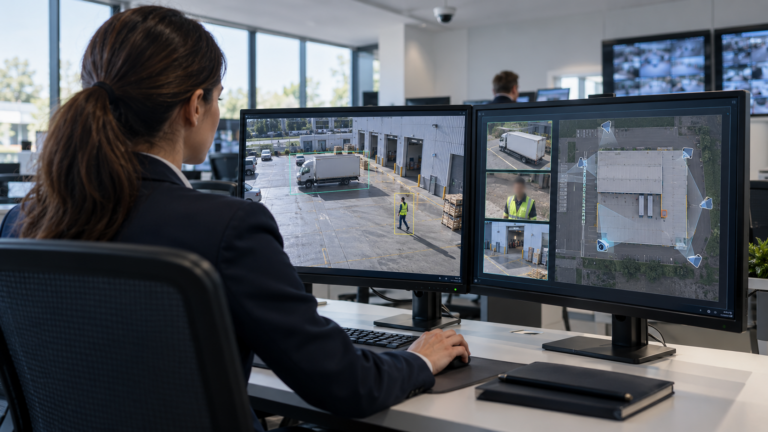
Beyond public safety, airspace security is emerging as a compliance expectation across enterprise environments. Critical infrastructure operators, logistics hubs and technology facilities are incorporating drone detection and tracking into regular physical security and risk audits. Insurance providers and assessors are starting to request proof of airspace monitoring capabilities, while airspace data is increasingly integrated into real-time awareness systems alongside perimeter, access control and building telemetry.
The report also points to a convergence between operational drone use and airspace protection. Agencies and enterprises are beginning to manage delivery drones, drones-as-first-responder fleets and CUAS platforms within a shared airspace picture. Detection, authorisation and deconfliction are expected to become increasingly automated, allowing public, commercial and enterprise users to operate through shared trust frameworks and common airspace intelligence.
Another emerging trend is the development of low-altitude “drone highways.” Regulators and major operators are introducing structured corridors around metropolitan areas and logistics hubs, supported by integrated unmanned traffic management and CUAS technology. These corridors are expected to form the foundation of a broader low-altitude transportation grid with clearer right-of-way rules.
For law enforcement and emergency response, drones are becoming standard equipment. Patrol officers are expected to carry small, rapidly deployable drones for indoor or confined-space operations, while dock-based patrol drones increasingly handle calls for service autonomously. This model allows agencies to gain continuous aerial visibility without proportionally increasing staffing levels.
The report also highlights the growth of shared air support networks. Neighbouring jurisdictions are beginning to pool docked drones through unified command dashboards, allowing police, fire and emergency medical services to access the same aerial assets. Cloud-based tasking and AI-assisted flight management are enabling operators to supervise multiple drones simultaneously during active incidents.
Regulatory changes are also shaping the airspace environment. The expansion of beyond visual line of sight operations is making large-scale delivery, inspection and response programs more common, while increasing authorised drone traffic is driving demand for unified airspace management that combines traffic coordination and defence. Other regions are moving toward similar standards to support consistent commercial operations.
In the defence sector, airspace protection is expanding into multi-domain uncrewed systems. Armed forces are increasing their use of uncrewed underwater, surface and ground vehicles, while testing micro-drones and bio-hybrid platforms that introduce new detection challenges. At the same time, nations are investing in interceptor drones capable of disabling hostile aircraft mid-air, even as adversaries move toward RF-silent and fully autonomous systems.
The report notes a broader shift among defence primes toward open architectures and faster integration cycles. Customers are showing less tolerance for closed systems and lengthy development timelines, pushing suppliers to adopt more flexible, software-driven approaches.
Finally, the study highlights a move away from border-focused “air walls” toward fully networked CUAS systems. Detection networks are expanding deeper within national territory, with regional coalitions forming to share drone signatures, telemetry and incident data. As automation plays a larger role in threat engagement, ethical and policy debates are intensifying around AI-supported decision-making and human oversight in airspace defence.