

Surge in Electro-Mechanical Hardware makes ongoing FM Training more important than ever
Allegion UK Commercial Leader Pete Hancox suggests that facilities management training needs to keep pace with rapidly developing building technologies for building and occupant wellbeing.
In the UK, the staff who manage our facilities can come from all walks of life. Ask any facilities manager about how they got into the trade, and then go and ask another, and you will more than likely get two different answers.
Why is this? Traditionally, people in the Facilities Management sector have often ‘fallen into’ the industry, explained the FMJ (Facilities Management Journal) in their ‘From the tools: The Making of the Manager?’ feature (March 2017). Our facilities managers could have worked their way up from frontline positions such as cleaning, catering, engineering or security. Increasingly, we can also see academic graduates choosing facilities management roles, too.
To become a facilities manager, the UK’s National Careers Service website simply states that “there are no set requirements, but you’ll usually need a qualification in facilities management.” Once you become a facilities manager, bodies like the British Institute of Facilities Management and Royal Institute of British Architects can provide training and CPD courses, but it is all optional to development – there is no legal requirement to train.
This is in stark contrast to other professions where wellbeing is concerned. Take gas engineers, for instance. Gas engineers in the UK, according to a leading jobs website, reed.co.uk, must have relevant qualifications, usually an NVQ Level 3 in Gas Installation, and also be Gas Safe registered. Apprenticeship is a common route for attaining a gas engineer position, too.
Of course, diversity in our industry is welcome, and diversity is known to bring outside-of-the-box solutions. However when we start comparing the two professions, we can start to see how gas engineers will be ‘singing from the same hymn sheet,’ whereas our facilities managers could be working from all manner of different pages.
For the future of facilities management, this very diversity could potentially be harming our buildings, and our occupants’ wellbeing, as opposed to aiding them. We could be creating an environment where knowledge levels, procedures, best practices and the way building hardware solutions are selected is all different and varied.
While it could be years before we reach a standardised route similar to that of gas engineers, we should at least be encouraging our facilities managers to complete ongoing training, particularly to keep pace with daily developments.
The Electro-Mechanical Game Changer
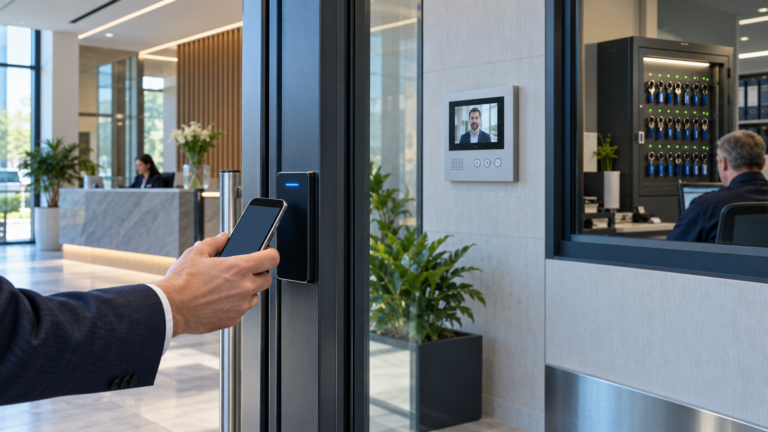
We are now coming to a stage in the door hardware industry where development is rapidly overtaking existing knowledge. Electro-mechanical ‘smart’ hardware means the ability to unlock doors from phones, control access to secure areas and remotely lockdown, these are all functions that would be greatly beneficial in any facility manager’s life.
Fully integrated building solutions and biometrics are also becoming more readily available and affordable, so that we can give our facilities managers greater control over their buildings, as well as scalability for the future.
Choosing the right solution is a lot more difficult though, one which requires a comprehensive analysis of the building, the users, the ongoing maintenance and the ability to upscale or upgrade in future.
Ongoing training is crucial in this respect. Without a proper understanding of the technology, it can be quite easy to make a decision that is not beneficial to the long term sustainability of the building. For the facilities management team, it can eventually lead back to compromising health and safety.
A case in point happened as recently as 2016, when a fire door in a hospital that was fitted with a self-closing device shut on an elderly patient, causing injury. Unfortunately, this injury contributed to that patient’s death. Intended to be an aid for the door, it has instead caused accident and a tragedy.
After the case, the Department of Health suggested that risk assessments should be carried out on all fire door closing devices to assess appropriate closing times, taking into account the occupancy of the building. For facilities managers who are ‘self-taught’ and have little knowledge in these electro-magnetic devices and risk assessments, we can immediately see how ongoing training in this area will benefit them.
The impact on health and safety compliance
Without question, the role of the facilities manager is to guarantee the health and safety of occupants, and there are strict guidelines and classifications to door hardware that must be met.
However, the varying level and difference in understanding of door hardware leads to different ideas between the supply chain. Architects strive for the aesthetic; facilities managers must comply with health and safety regulations but also meet budgets; installers and contractors look for products that are retrofit, or quick and easy to install, and choice of hardware becomes based on those factors.
As a result, while compliance standards can be met, these competing forces mean the solution or hardware that is chosen may not be best for the users.
Fire doors are another area that require debate and thought. Heavy in nature, but a necessity to fire safety, they can become dangerous when the hardware used with them does not facilitate easy passage or use. Primary school children may not have the strength to push open doors, while in care homes, mobility and escape in a fire situation becomes an issue.
The easy, perhaps even cost-effective, option would be to select a manual fire door closer, compliant to the weight of the fire door. However, we would advise in these situations to help those building occupants by choosing an electromagnetic door closer instead that is linked to the fire alarm system. In this way, you can legally hold open fire doors, aid daily passage and use, reduce wear and tear and still stay within compliance.
Another case where an electromechanical device could potentially have prevented injury occurred in 2015, where a mother claims her five-year-old daughter lost part of her finger in a fire door at school after being left unsupervised.
Margaret Chan’s daughter got her finger caught in the heavy fire door at Cuddington Croft Primary School in Cheam, Surrey. The incident is claimed to have occurred after the child was left unattended after being “sent back into the school building toilet alone unsupervised via a classroom where there are two fire doors”, said Margaret. The school could not tell the mother what had happened, as the incident was ‘unwitnessed’ (Daily Mail, 2015).
Short-term costs, long-term gains
As with all training, there is an associated cost. It can be hard to see past this cost if benefits are viewed as minimal or not even applicable to current situations. In facilities management, it is even harder to see why we need training in disciplines such as biometrics or computer-aided systems, when traditionally these applications have only been used in select, sensitive buildings.
However, we as manufacturers are constantly exploring technology that can enhance door hardware capabilities and the customer experience, simply because it is our duty to continue innovating for the better. Technologically enhanced door hardware will soon be more accepted as the norm as we become accustomed to the benefits it offers, as well as if costs on such hardware continues to fall.
Therefore, if we do not encourage our facilities managers to train, in the end we are ultimately costing more to our buildings, and to the welfare of our occupants, than the initial outlay of training may be suggesting.
[su_button url=”http://www.allegion.com/corp/en/index.html” target=”blank” background=”#df2027″ color=”#ffffff” size=”10″ radius=”15″ icon=”icon: arrow-circle-right”]Click here to find out more about Allegion[/su_button]