

Up until recently, physical security has been almost entirely built around two things: visibility, and response. The systems we’ve relied on have been designed to capture events rather than interpret them – and for a long time that was enough!
But as environments become more complex and the potential risks harder to predict, simply watching and responding just doesn’t cut it anymore.
AI is transforming almost every industry, physical security included. While it’s not replacing the important role of guards and patrols, it’s certainly playing a part in reshaping how we operate. From predictive threat detection to intelligent video analytics and automated access control, AI is helping to shift security from reactive to proactive.
As Triton Security explores, the hopeful outcome is a shift towards security operations that respond earlier to threats – perhaps even before they happen – and makes better use of real-time intelligence to build a safer society.
From passive surveillance to intelligent monitoring
Traditional CCTV systems generate enormous amounts of footage. The problem with this system isn’t a lack of visibility – it’s the lack of real-time interpretation – as it would be simply impossible for a human to analyse every frame.
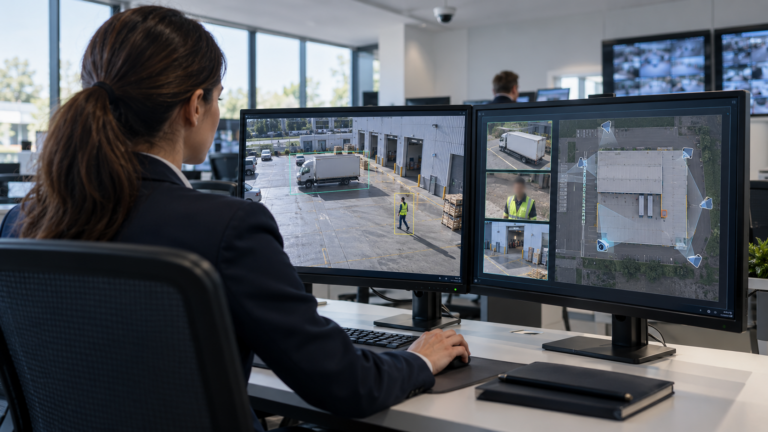
This is one area where AI video analytics can have an impact through:
- Detecting and flagging unusual behaviour patterns
- Spotting perimeter breaches
- Being able to recognise people or vehicles
- Faster distinguishing between genuine and false alarms
- Triggering automated alerts based on predefined risk indicators
Instead of relying on, and expecting, human operators to monitor multiple screens and respond reactively, AI is able to act as an amplifier; flagging high-risk events and prioritising responses.
Predictive risk assessment
One area where AI can massively contribute to physical security is through its predictive capabilities.
No human can remember every suspicious vehicle or person of interest, but by analysing historical incident data, environmental factors, behavioural signals, and even traffic patterns, AI is able to forecast periods of heightened risk, spot vulnerable access points that may be being exploited, and make suggestions with regards to patrol routes and staffing based on the analysis.
It can even detect anomalies before they even become incidents, giving physical security teams the knowledge and insight to act proactively rather than reactively.
Enhancing, never replacing
There is a concern across industries, not just security, that AI and automation will overtake traditionally human-led areas. However, it’s important that AI is used as an augmentation for physical security rather than a complete replacement – that human-judgement and instinct will always be required.
Security personnel have that on-the-ground perspective that AI just can’t replicate, in the form of de-escalation skills, incident management, client-facing assurance, and knowledge of legal and compliance requirements.
AI can be trained to handle the heavy-lifting with data, the large-scale processing, repetitive monitoring and pattern recognition, leaving the strategy and decision-making to the humans. This combined approach gives teams far stronger outcomes than either could achieve alone.
Responsible deployment
Another issue raised with the continued development of AI is governance and responsible deployment. Companies who do make use of AI to enhance their physical services must commit to carefully managing data retention policies, ensure transparency in biometric use, mitigate bias in recognition systems, maintain high ethical standards, and fully comply with regulatory frameworks such as GDPR.
Integrating AI into physical security services will not only depend on the technical capabilities, but on trust between the company and the public.
What’s next?
The future of physical security is complex and ever-evolving, but its success lies in connected and intelligent ecosystems. The boundaries are blurring, and as physical and digital converge – both in threats and protection – security systems must adapt and operate holistically, with AI acting as the connective intelligence that allows the next phase of integration.