

In March during a press event at Paxton headquarters, Managing Editor Rebecca Spayne caught up with CEO Adam Stroud to discuss the launch of market disrupter, Solo
What was the thinking behind developing Paxton Solo, and why launch it now?
The starting point for Solo was deliberately unconventional. Rather than iterating on existing platforms, we began with a blank sheet of paper and asked a simple question: if you were designing an access control system today, using current technology and without legacy constraints, what would it look like? That mindset shaped everything that followed.
Traditional systems rely on layers of hardware, control units, readers, servers, and infrastructure that have evolved over decades. Solo strips that back. It uses the capabilities that already exist in smartphones, cloud platforms, and modern connectivity to remove unnecessary components. The result is a system that is not only simpler but also inherently more secure because it reduces the number of potential vulnerabilities.
The timing is important. We are at a point where users are comfortable with mobile-first interaction, cloud management, and passwordless authentication. Those shifts make it possible to deliver something genuinely different, rather than just incrementally better.
How does Solo differ technically from traditional access control systems?
The key difference is in the architecture. A conventional system typically requires a control panel, readers, credentials, and often an on-site server. Solo removes much of that. At the door, you have a compact controller with Bluetooth capability, paired with a simple NFC door tag. Management happens through a mobile app, and the intelligence sits in the cloud.
That means commissioning, user management, and reporting are all handled through the app. There is no need for dedicated software installations or complex network setups. It is designed to be intuitive, but also scalable. You can manage a single door or expand to a much larger deployment without fundamentally changing the approach.
We have also adopted passwordless authentication. Instead of relying on traditional credentials, users authenticate through secure email links, and in the future, passkeys. That reflects broader changes in cybersecurity and removes a common point of failure.
Security is a central claim. What makes Solo, a secure systems on the market?
Security comes from both simplification and modernisation. By reducing hardware dependencies and moving intelligence into the cloud, you eliminate a number of traditional attack surfaces. At the same time, you can apply contemporary security practices such as encrypted communication, regular updates, and modern authentication methods.
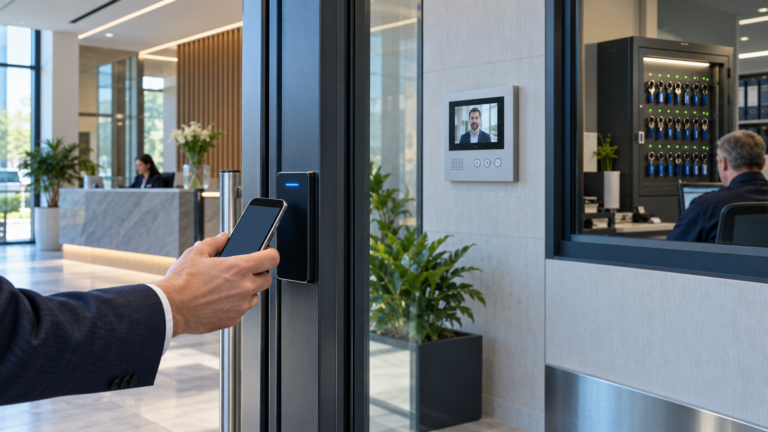
Another aspect is the use of smartphones as credentials. Phones are already highly secure devices, with biometric protection and encrypted storage. Leveraging that existing security infrastructure is far more robust than relying on standalone cards or fobs.
It is also about how the system is managed. Because everything is centralised and cloud-based, updates and improvements can be deployed continuously. That is a significant shift from legacy systems, where upgrades can be slow and fragmented.
You mentioned cost as a disruptive factor. How does Solo change the economics for installers and end users?
Cost is a major barrier in access control, particularly for smaller or more temporary applications. Traditional systems can be expensive to deploy because of hardware, installation complexity, and ongoing maintenance.
Solo changes that equation. The system is priced significantly lower than comparable networked solutions, and the installation process is simpler. That opens up new opportunities for installers, not just in terms of volume but also in terms of margin.
We have also introduced a freemium model. For a single door and user, the system is free to use. That lowers the entry barrier and allows people to experience the technology without commitment. From there, they can scale as needed.
For installers, it creates a different kind of conversation with customers. Instead of focusing on cost constraints, they can focus on functionality and flexibility.