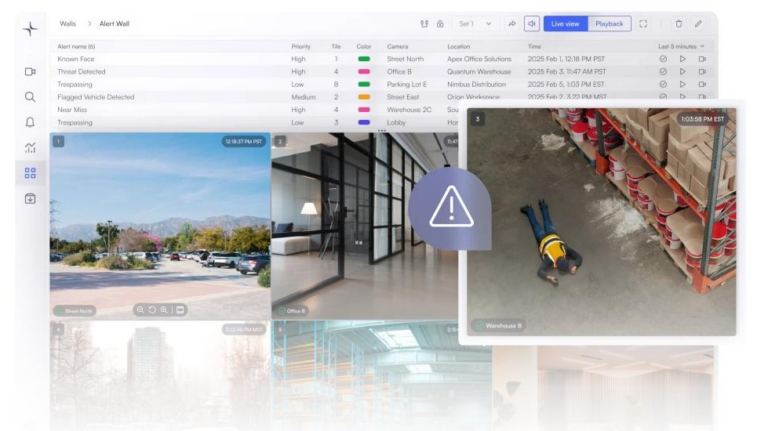


Domenico Scordo of Seagate explains how AI, higher-resolution cameras and video analytics are reshaping security storage infrastructure.
Please introduce yourself and give us an insight into Seagate.
I’m Domenico Scordo, Senior Sales Manager for Northern Europe at Seagate Technology. My role focuses on supporting our partners and customers across the video imaging and analytics (VIA) ecosystem, helping them design and deploy infrastructure capable of meeting the rapidly growing demands of modern security.
Seagate has long been at the forefront of data storage innovation. Today, we play a critical role in enabling the security industry to capture, store and analyse vast volumes of video data. As security systems evolve from simple recording tools into intelligent, AI-driven platforms, storage has become a foundational component of security infrastructure, not just a backend consideration. Our focus is to ensure that organisations can scale confidently, retain critical data securely, and unlock value from video through advanced analytics.
The volume of video generated by modern security systems continues to increase dramatically. What are the primary factors driving this growth, and how is it changing the way organisations approach security infrastructure?
There are three primary drivers behind the exponential growth in video data. First, higher resolution cameras, such as 4K and beyond, are now standard in many deployments. These capture significantly more detail but also generate substantially larger files.
Key indicators include:
- Example 1
- Example 2
- Example 3
Second, the increase in camera density. Organisations are deploying more cameras per site than ever before, covering wider areas and multiple angles to enhance situational awareness.
Third, and perhaps most impactful, is the rise of AI and video analytics. Systems are no longer just recording footage; they are actively analysing behaviour, identifying objects, and generating insights. This requires more data to be captured, stored, and processed, often for longer periods.
As a result, organisations are shifting from a reactive approach to infrastructure toward a more strategic one. Storage is no longer sized just for today’s requirements; it must be designed with future data growth, analytics workloads, and compliance needs in mind. We’re also seeing a strong move toward purpose-built security storage solutions that prioritise workload optimisation, reliability, and scalability.
What are the biggest challenges organisations face when scaling security systems across multiple sites, cities or countries?
Scaling security infrastructure introduces both technical and operational complexity.
One of the key challenges is data consistency and accessibility. Organisations need to ensure that video data from multiple locations can be accessed, analysed, and managed centrally without compromising performance.
Another major challenge is network bandwidth. Moving large volumes of video data between sites or to centralised locations can strain network resources, especially when real-time analytics are involved.
There’s also the issue of regulatory compliance, which varies significantly across regions. Different countries may have strict requirements around data sovereignty, retention periods, and privacy, which organisations must carefully navigate.
Finally, system interoperability can become a barrier. Large-scale deployments often involve multiple vendors and technologies, and ensuring seamless integration between cameras, VMS platforms, and storage infrastructure is critical.
To address these challenges, organisations are increasingly adopting hybrid architectures that combine local storage with centralised management and analytics.
Many organisations are being asked to retain video data for longer periods while increasing image quality and analytics capabilities. How is this changing infrastructure planning and investment decisions?
This is fundamentally reshaping how organisations think about storage.
Longer retention periods, combined with higher-resolution footage and analytics-enriched data, are driving a dramatic increase in storage capacity requirements. However, it’s not just about adding more capacity, it’s about doing so intelligently.
Organisations are moving toward tiered storage strategies, where frequently accessed data is kept on high-performance systems, while older data is stored in more cost-efficient, high-capacity solutions.
We’re also seeing increased focus on total cost of ownership (TCO) rather than just upfront costs. Factors such as power consumption, drive density, reliability, and maintenance are becoming key considerations in infrastructure decisions.
Importantly, storage is now being viewed as an enabler of value. By retaining more data and applying analytics over longer periods, organisations can derive insights that go beyond security – supporting operational efficiency, safety improvements, and even business intelligence.
What are the most common mistakes organisations make when designing storage architectures for future growth?
One of the most common mistakes is underestimating future data growth. Many systems are designed based on current requirements, without adequate accounting for increases in camera resolution, analytics usage, or retention policies.
Another mistake is treating storage as a generic component. Security workloads are highly specialised; they require systems that can handle continuous, write intensive operations 24/7. Using non-optimised storage can lead to performance bottlenecks or reduced reliability.
Organisations also sometimes overlook scalability and flexibility. Infrastructure should be designed to expand seamlessly without requiring major reconfiguration or downtime.
Finally, there is often insufficient attention paid to data management and lifecycle planning. Without clear strategies for how data will be stored, accessed, and eventually archived or deleted, systems can quickly become inefficient and costly.
How can organisations balance the need for scalability with budget constraints while maintaining the performance required for security operations?
Balancing these priorities requires a strategic approach.
First, organisations should adopt modular, scalable architectures that allow them to expand capacity incrementally as needs grow. This avoids large upfront investments while ensuring flexibility.
Second, optimising storage efficiency is key. Technologies that increase drive density and maximise usable capacity can significantly reduce the physical footprint and associated costs.
Third, organisations should look at workload-specific solutions. Purpose-built security drives and systems are designed to deliver consistent performance under demanding conditions, reducing the risk of failures and costly downtime.
Finally, taking a long-term view of cost is essential. Investing in reliable, high-capacity solutions may have a higher initial cost but often results in lower TCO over time through reduced maintenance, lower energy consumption, and improved system longevity.

What role do edge and centralised storage strategies play in supporting large-scale security deployments?
Both edge and centralised storage play critical, and complementary, roles.
Edge storage allows data to be captured and stored close to where it is generated. This reduces latency, minimises bandwidth usage, and ensures continued operation even if network connectivity is disrupted.
Centralised storage, on the other hand, enables aggregation of data from multiple sites, supporting advanced analytics, long-term retention, and unified management.
In practice, most large-scale deployments use a hybrid approach, combining the strengths of both models. Video is often recorded at the edge for performance and resilience, then selectively transferred to central systems for analysis, archiving, or compliance purposes.
This hybrid strategy provides the flexibility needed to handle diverse operational requirements while maintaining efficiency and scalability.
How is the growth of AI impacting storage requirements and long-term data management strategies?
AI is having a profound impact on storage.
Firstly, AI-driven analytics require larger datasets to train and operate effectively. This increases both the volume of data that must be stored and the importance of maintaining data integrity over time.
Secondly, AI introduces the need for high-performance data pipelines. Storage systems must be able to deliver data quickly and reliably to support real-time or near-real-time analytics.
Thirdly, AI is extending the value of stored data. Video footage is no longer just archived—it’s a resource that can be revisited and re-analysed to extract new insights. This is driving the need for long-term, cost-efficient storage solutions.
Overall, AI is shifting storage from a passive repository to an active component of the analytics ecosystem.
Looking ahead, what steps should security leaders take today to future-proof their infrastructure investments against the continued growth of video data and emerging technologies?
Future-proofing requires a proactive and forward-looking strategy.
Security leaders should start by planning for scalability from day one, ensuring their infrastructure can accommodate future increases in data volume and complexity.
They should also prioritise interoperability and open standards, enabling integration with evolving technologies and avoiding vendor lock-in.
Investing in high-capacity, purpose built storage is critical, as is adopting architectures that support both edge and centralised deployments.
Data management should also be a key focus. Organisations need clear policies around retention, access, and lifecycle management to ensure efficiency and compliance.
Finally, it’s important to recognise that storage is not just an operational necessity – it’s a strategic asset. By building robust, scalable infrastructure today, organisations can unlock the full value of video data in the future.
Anything else to note?
One important point is that the role of video data is expanding rapidly beyond traditional security.
Today, organisations are using video insights to improve operational efficiency, enhance safety, and support decision-making across a wide range of industries, from retail and transportation to smart cities.
As this trend continues, the importance of robust, scalable, and intelligent storage infrastructure will only increase. Those who invest strategically now will be best positioned to capitalise on the opportunities ahead.