

Gordon Swallow, Regional Business Development Manager, UKI, Gallagher Security explores security systems for commercial buildings
Please introduce yourself and give us an insight into your background.
I’ve spent almost 20 years at Gallagher Security, across a range of senior sales and business development roles, and for the last while I’ve been focused on the London market as UK South Sales Manager. My background is in intelligent commercial access control, and a lot of my day-to-day is spent working closely with End Users and building strong partnerships with key integrators in a market that moves fast and expects a lot from its buildings. I’m a genuine advocate for what integration can unlock when it’s done well, not just for security’s sake but for the experience it creates for the people using a building.
What are the most significant security challenges currently facing commercial building owners and operators, and how are these requirements changing as buildings become more connected and digitally managed?
The definition of a smart building has shifted. It used to be about backend efficiency, with lighting, HVAC and energy systems reacting automatically to inputs. Today, intelligence is judged by how the environment responds to the people inside it, from the moment someone approaches the entrance to the point they settle at their desk.
A big driver of that shift is the changing shape of the workforce itself. In a post-pandemic world, working from home is an option for many, and corporates are having to think hard about what gets people back into the office. Increasingly the answer isn’t mandate, it’s experience. Smart, well-designed buildings can be a real driver of that engagement, giving people a reason to want to come in. That puts pressure on owners and operators: buildings are competing for occupants, not just housing them, and security has a direct role to play in making that experience feel worth the commute.
That competition also creates a genuine security challenge. Underlying systems must be ready to support whatever that competition demands next. Few major developments now proceed without asking whether a building will be “smart-ready,” and even when every feature isn’t switched on immediately, stakeholders want confidence that the infrastructure can provide future integration. That means systems need to support robust APIs from day one. Mobile credentials add another layer to this. As adoption accelerates, major developments are having to carefully examine how credentials are issued, stored and managed, often in close collaboration with IT teams, because the primary driver of change is usability, not a weakness in the traditional access card. The challenge, in short, is designing security that keeps pace with rising tenant expectations and growing businesses, competes with the option of staying home, and does it all without compromising safety and control.
Beyond traditional access control and physical protection, where can an integrated security solution deliver wider operational value within a commercial building?
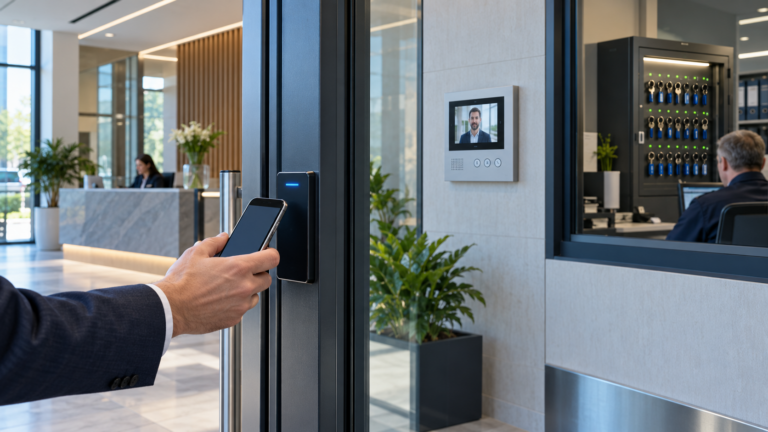
The building itself starts to function as a platform. A single credential inside a digital wallet can become an entry key, an identity token and a gateway to everything the building offers, from lockers and lifts to on-site retail and shared amenities. That’s where the operational value goes well beyond protection. For landlords and developers, intelligent features that connect everything from access to car parks and visitor management from a single platform help attract and retain tenants, differentiate a property in a competitive market, and in some cases open up entirely new revenue opportunities through integrated services and promotions. Security stops being a cost centre and starts being part of what makes a building commercially competitive.
How can security systems support a better experience for tenants, employees and visitors while still maintaining the appropriate level of protection and control?
This is really the “street to seat” idea. From the moment someone approaches a campus or steps into reception, technology should support the journey rather than interrupt it, removing friction and anticipating needs so the whole experience feels almost invisible. That doesn’t mean one size fits all. Intelligence is contextual. A high-profile financial institution will prioritize discretion and tightly controlled movement, while a creative workspace might emphasize shared amenities and easy collaboration. Both can be genuinely intelligent buildings, because intelligence is shaped by the purpose of the building and the expectations of the people using it. The security system’s job is to enable whichever version of that experience the building needs, without the person moving through it ever having to think about it.
There’s also a bigger conversation happening in commercial real estate right now about the culture of a building, and how developers want it to be perceived and felt: open, safe, engaging, creative, inspirational. Security plays a real part in shaping that identity, whether it’s a discreet, controlled environment or an open, collaborative one. The system isn’t just managing entry; it’s helping define what kind of building this is.
How can the Gallagher Command Centre help commercial building operators bring together access control, monitoring and day-to-day security management more effectively?
Command Centre gives operators a single platform for access control, monitoring and day-to-day site security, but where it’s really come into its own recently is how it extends into the wider workplace experience. A good example is our Visitor Management solution powered by Kenai. Rather than sitting as a separate system, it connects directly into the Command Centre environment operators already rely on, layering in visitor sign-in, safety inductions, parking booking and other day-to-day workplace workflows on top of the access control and security foundation that’s already in place. Kenai especially comes into its own in multi-tenant commercial buildings, where property managers keep complete oversight while each tenant manages their own secure account and branded visitor experience. Command Centre itself is built with flexibility in mind too, so where a site has existing third-party visitor management they want to keep, Command Centre integrates with that just as readily. That adaptability is part of what makes the platform work for such a wide range of buildings.
For operators, this unified platform view means less manual admin, better visibility over who’s on site and why, and a clear digital audit trail that supports compliance without adding extra work for the security team. It also means visitors and employees get a faster, more seamless experience from the moment they arrive, which matters more than ever when that first interaction shapes how people feel about a building.
What are the benefits of greater integration than just security, and what should organisations consider when developing this type of connected environment?
When a building app can promote events, share updates, offer discounts in on-site retail and connect occupants to shared amenities, technology becomes part of the building’s personality rather than a background utility. That’s the upside. But the more systems you connect, the more services depend on that digital interaction working reliably, so the reliability of the core infrastructure becomes increasingly critical. Without that stability, intelligence quickly becomes fragile. Organizations developing a connected environment need to treat that foundation, the ability to manage movement securely and consistently, as non-negotiable before layering on new digital services. Flexibility matters too. Intelligent buildings are rarely delivered in a single moment; they evolve as technologies advance and tenant expectations change, so the platform needs to be built to expand rather than be replaced.
When investing in a new or upgraded security solution, how should commercial building owners measure its long-term value?
The security investment conversation is changing. For decades, security ROI was solely measured in incident response, physical protection, and risk containment. Modern security systems connect people, data, and physical space in ways that create value well beyond protection. Access data can inform how a building’s workforce uses the space. Event logs strengthen compliance reporting. The same controls that secure the front door can also flag energy waste, recover time lost to manual admin, and build a clearer picture of how a site really operates. That value is genuine and measurable, but it rarely gets counted because it doesn’t fit the old definition of what security is “for.”
So, my advice to owners is to widen the lens. Don’t just ask whether the building is protected, ask what the infrastructure you’re investing in can actively do for the rest of the business, what experiences it can enable, and what efficiencies it gains. The organizations getting the most out of their security spend are the ones treating it as an opportunity to unlock value elsewhere, not just a cost of doing business.