

Zenon Kohs, Channel Sales Manager for the UK at DoorBird, discusses the company’s new D22x Series, exploring how changing building requirements are influencing door communication, access control, system integration and modernisation.
What prompted the development of the new D22x Series?
Modern buildings are placing increasingly complex demands on door communication systems. Property owners, operators and residents are no longer looking for a standalone intercom; they need systems that can accommodate different user groups, provide flexible access methods and integrate with wider security and building management infrastructure.
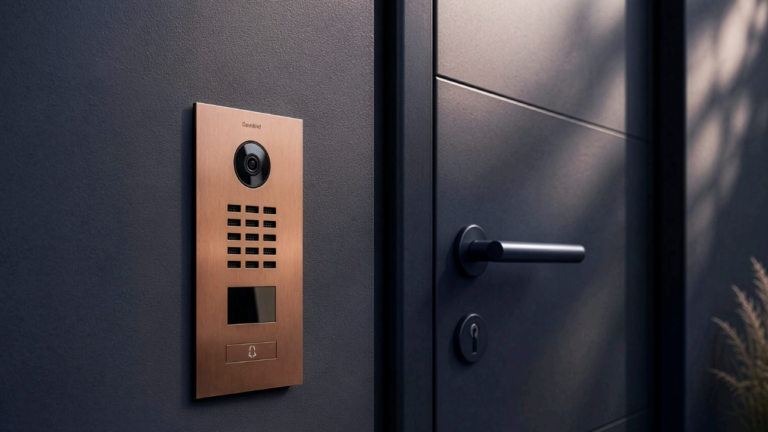
The D22x Series was developed around those requirements. It is the direct successor to our D21x Series and includes more than 30 models, giving customers considerable flexibility depending on the building and application. The objective was to combine door communication, access control, connectivity and design within one adaptable platform while retaining the quality and manufacturing standards associated with our production in Germany.
What are some of the main technology upgrades within the D22x Series?
One of the key developments is the camera. Every model features a 5 MP HDR camera with a Sony image sensor and a 180-degree ultra-wide-angle lens, providing a wide field of view at the entrance. Video can be transmitted in HD quality either across the local network or through DoorBird Cloud Pro.
We have also focused heavily on the audio experience because clear communication remains fundamental to any door intercom system.
Depending on the chosen model, customers can also use several different authentication methods, including the DoorBird app, dual-frequency RFID, Bluetooth, PIN codes, QR codes and fingerprint recognition. A radar-based 4D motion sensor and integrated tamper sensor provide additional security functionality.
How does the series address the requirements of larger residential and commercial properties?
Scalability was an important consideration. The platform can support installations with up to 3,000 residential or office units, so it is suitable for everything from smaller properties through to significant multi-occupancy developments.
We have also introduced models with digital nameplates and displays incorporating resident directories. These can be managed centrally and remotely, which can be particularly useful for property managers, housing associations and commercial operators because changes no longer necessarily require someone to attend the property and physically replace a nameplate.
Accessibility has also been considered. Features including hearing loops, pictograms and acoustic door-opening confirmation signals can be incorporated across the range.
Installation and integration remain important considerations for installers. How has this been addressed?
We have tried to simplify installation wherever possible. The D22x includes an integrated power output for electric door openers, meaning that many installations no longer require an additional power supply specifically for the door release. That can reduce both cabling and installation work.
Integration is equally important because door communication increasingly sits within a broader security ecosystem. The D22x supports interfaces including SIP, OSDP, RS485 and Wiegand, alongside our documented LAN and Cloud APIs.
That allows integration with more than 100 smart home, access control, video surveillance and building management systems. Customers increasingly want technologies that work together rather than separate systems operating independently, so openness is an important part of the platform.
Cybersecurity is becoming increasingly important within connected building systems. How is DoorBird approaching this?
Connected security products need to be developed with information security and privacy in mind from the beginning rather than added afterwards.
DoorBird is an ISO/IEC 27001-certified company, and privacy and information security measures are incorporated throughout the development process in accordance with the Security by Design principle.
As systems become more interconnected, customers are understandably paying greater attention to how manufacturers manage security, data and product development. It is therefore important that these considerations form part of the overall product architecture.
What options does the D22x Series provide for customers with existing DoorBird installations?
We wanted existing D21x customers to have a practical route to modernisation without unnecessarily replacing hardware that remains perfectly usable.
For many upgrade projects, only the main electronic unit needs to be replaced. Existing housings, front panels and other components can remain in place, and existing settings can also be retained.
This reduces installation work and cost while also supporting a more sustainable approach because customers are not being asked to remove and discard components unnecessarily simply to gain access to newer technology.
How important is design when specifying door communication technology today?
Technology is only part of the consideration, particularly because a door station is usually installed in a highly visible position at the entrance to a property.
The D22x Series is therefore available in more than 50 finishes and colour options, allowing it to work within a wide range of architectural environments, from private residential properties through to larger commercial buildings.
Our 3D Configurator also allows customers to adapt systems around individual project requirements. Front panel dimensions and shapes, engravings, mailboxes and third-party reader units can all be configured.
Ultimately, modern buildings need door communication systems that are flexible rather than restrictive. The D22x has been designed as a platform that can adapt to different access requirements, integrations and architectural environments while providing a clear upgrade path as those requirements continue to develop.