

Michael Lawrence, Marketing Director at Dahua Technology UK & Ireland, explores how AI is transforming video surveillance into actionable operational intelligence
Modern security is being transformed, with AI enabling new solutions and greatly enhancing the efficiency of existing ones. Artificial intelligence has a practical role in video storage, for example. Super AI Coding analyses a scene and gives more bitrate, the amount of video data transmitted each second, to people, vehicles and other useful details. Less important background receives less data. Storage can be reduced by up to 50 per cent against standard H.265, a codec that compresses video for recording and transmission.
Those savings matter. Hard drive costs have risen sharply, while higher image resolutions and longer retention periods demand more capacity. It can also reduce network bandwidth.
From Smarter Storage to Smarter Operations
Retail shows how the same infrastructure can move beyond recording. Compatible camera feeds can connect to an intelligent video device (IVD), or a high-specification network video recorder. AI can flag suspicious behaviour such as item concealment, triggering an event for rapid evidential capture.
The operational uses are just as valuable. Shelf inspection can identify low stock or unusual product removal. People counting measures footfall, while heat maps show where customers gather and how they move. Retailers can use this information to plan staffing, checkout capacity, store layouts and promotions. The quality of those decisions still depends on camera position, calibration and consistent operating conditions.
Natural Language Search and Real-Time Response
Multimodal AI connects video with natural language. Dahua’s WizSeek allows an operator to enter a description, such as a person in a red coat carrying a box, into a search bar. A review that once took hours or days can return likely matches in seconds. This could help investigations in retail, transport, campuses and public venues, but operators must check results and manage access, retention and privacy carefully.
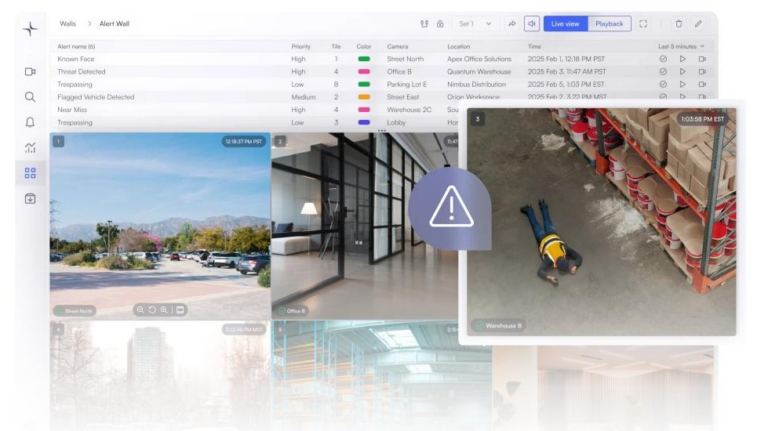
Text Defined Alarms extend the idea from investigation to live response. Once a user describes a visual condition, compatible processing hardware looks for it and creates an event. In a warehouse, that might be a forklift entering a pedestrian area or boxes blocking a fire exit. On a construction site, it could be someone without the required personal protective equipment, or PPE. In a public event, it could be a rucksack passed an entry point.
The applications are endless, including traffic, finding collisions, wrong-way driving, and industrial parks and power stations, where teams can search for safety breaches or create site-specific alerts. Edge AI, meaning analysis on the camera or local recorder, can cut latency and avoid sending every stream to the cloud. Cloud platforms and a video management system, or VMS, can provide central oversight across several sites.
There are trade-offs. Older cameras may lack the resolution, angle or stream quality needed for reliable analytics, even if they connect through ONVIF, an open standard for linking video products. Cloud services add licensing, connectivity, cyber security and data residency questions. AI is strongest when it narrows attention and speeds decisions. It doesn’t replace good design, careful commissioning or human judgement.