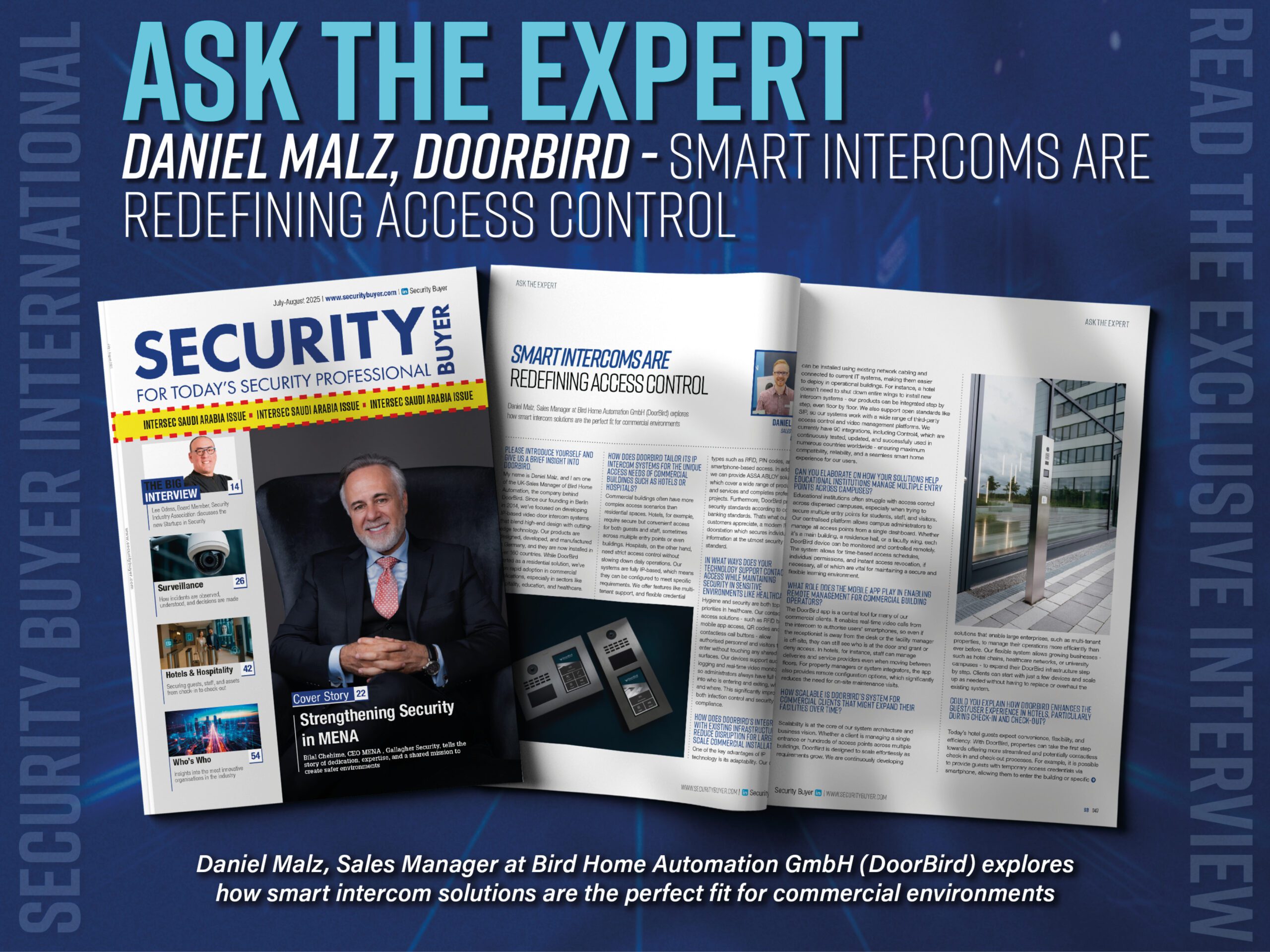

Daniel Malz, Sales Manager at Bird Home Automation GmbH (DoorBird) explores how smart intercom solutions are the perfect fit for commercial environments.
Please introduce yourself and give us a brief insight into DoorBird.
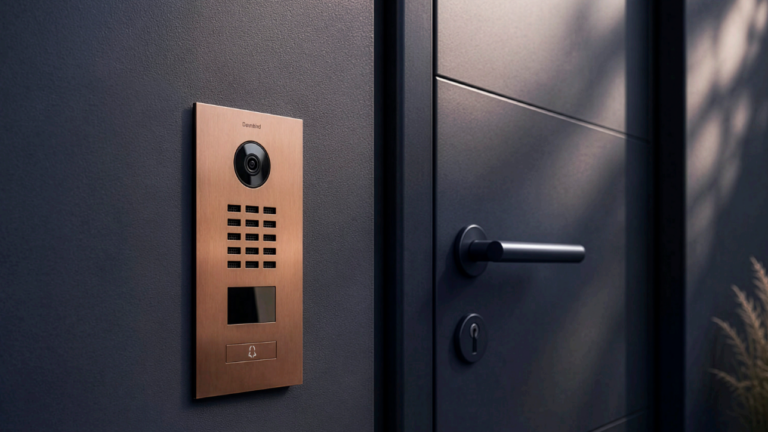
My name is Daniel Malz, and I am one of the UK-Sales Manager of Bird Home Automation, the company behind DoorBird. Since our founding in Berlin in 2014, we’ve focused on developing IP-based video door intercom systems that blend high-end design with cutting-edge technology. Our products are designed, developed, and manufactured in Germany, and they are now installed in over 160 countries. While DoorBird started as a residential solution, we’ve seen rapid adoption in commercial applications, especially in sectors like hospitality, education, and healthcare.
How does DoorBird tailor its IP intercom systems for the unique access needs of commercial buildings such as hotels or hospitals?
Commercial buildings often have more complex access scenarios than residential spaces. Hotels, for example, require secure but convenient access for both guests and staff, sometimes across multiple entry points or even buildings. Hospitals, on the other hand, need strict access control without slowing down daily operations. Our systems are fully IP-based, which means they can be configured to meet specific requirements. We offer features like multi-tenant support, and flexible credential types such as RFID, PIN codes, and smartphone-based access. In addition, we can provide ASSA ABLOY solutions which cover a wide range of products and services and completes professional projects. Furthermore, DoorBird provides security standards according to common banking standards. Thats what our customers appreciate, a modern IP doorstation which secures individual information at the utmost security standard.
In what ways does your technology support contactless access while maintaining security in sensitive environments like healthcare?
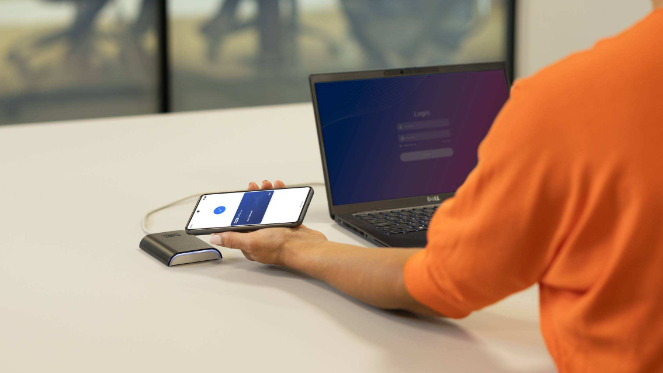
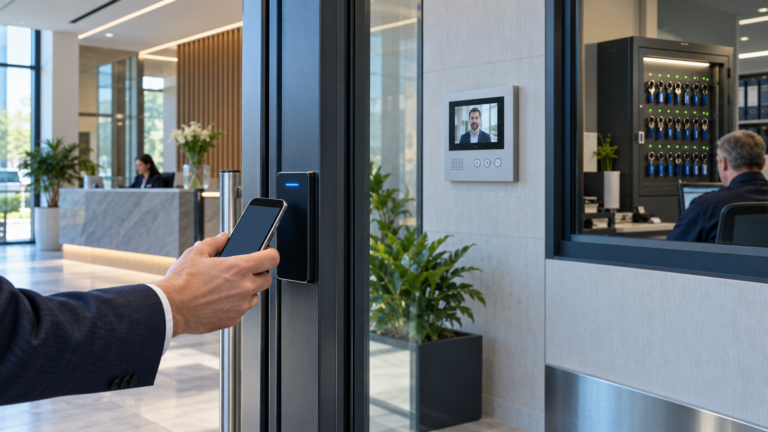
Hygiene and security are both top priorities in healthcare. Our contactless access solutions – such as RFID badges, mobile app access, QR codes and contactless call buttons – allow authorised personnel and visitors to enter without touching any shared surfaces. Our devices support audit logging and real-time video monitoring, so administrators always have full visibility into who is entering and exiting, when, and where. This significantly improves both infection control and security compliance.
How does DoorBird’s integration with existing infrastructure reduce disruption for large-scale commercial installations?
One of the key advantages of IP technology is its adaptability. Our devices can be installed using existing network cabling and connected to current IT systems, making them easier to deploy in operational buildings. For instance, a hotel doesn’t need to shut down entire wings to install new intercom systems – our products can be integrated step by step, even floor by floor. We also support open standards like SIP, so our systems work with a wide range of third-party access control and video management platforms. We currently have 90 integrations, including Control4, which are continuously tested, updated, and successfully used in numerous countries worldwide – ensuring maximum compatibility, reliability, and a seamless smart home experience for our users.
Can you elaborate on how your solutions help educational institutions manage multiple entry points across campuses?
Educational institutions often struggle with access control across dispersed campuses, especially when trying to secure multiple entry points for students, staff, and visitors. Our centralised platform allows campus administrators to manage all access points from a single dashboard. Whether it’s a main building, a residence hall, or a faculty wing, each DoorBird device can be monitored and controlled remotely. The system allows for time-based access schedules, individual permissions, and instant access revocation, if necessary, all of which are vital for maintaining a secure and flexible learning environment.
What role does the mobile app play in enabling remote management for commercial building operators?
The DoorBird app is a central tool for many of our commercial clients. It enables real-time video calls from the intercom to authorise users’ smartphones, so even if the receptionist is away from the desk or the facility manager is off-site, they can still see who is at the door and grant or deny access. In hotels, for instance, staff can manage deliveries and service providers even when moving between floors. For property managers or system integrators, the app also provides remote configuration options, which significantly reduces the need for on-site maintenance visits.
How scalable is DoorBird’s system for commercial clients that might expand their facilities over time?
Scalability is at the core of our system architecture and business vision. Whether a client is managing a single entrance or hundreds of access points across multiple buildings, DoorBird is designed to scale effortlessly as requirements grow. We are continuously developing solutions that enable large enterprises, such as multi-tenant properties, to manage their operations more efficiently than ever before. Our flexible system allows growing businesses – such as hotel chains, healthcare networks, or university campuses – to expand their DoorBird infrastructure step by step. Clients can start with just a few devices and scale up as needed without having to replace or overhaul the existing system…