

Rebecca Spayne of Security Buyer sat down with Stuart Bettle, Video Product Manager, Johnson Controls to discuss selecting the right surveillance camera and understanding operations while balancing cost. Watch the full video here.
The surveillance industry has changed dramatically over the past decade. Advances in imaging technology, processing power and AI have transformed cameras from simple recording devices into intelligent sensors capable of supporting security, safety and operational decision-making. With more camera formats and specifications available than ever before, selecting the right solution is no longer about choosing the highest resolution or the lowest price. Instead, it requires a clear understanding of the environment, the operational risks and what the customer ultimately wants to achieve. Stuart Bettle, Video Product Manager at Johnson Controls, explains how installers and end users can make better-informed decisions when specifying surveillance systems.
Why has the surveillance industry developed so many different camera formats rather than converging on a single design?
I think technology has really driven that evolution. If you go back a number of years, the choices were relatively straightforward. You generally selected a box camera, chose the lens you wanted, decided whether it needed to be colour or monochrome and selected the appropriate sensor depending on whether it was going indoors or outdoors. Compared with today, there were very few decisions to make.
As camera technology has advanced over the last decade or so, those choices have increased dramatically. Higher resolutions, more processing power and new hardware capabilities have allowed manufacturers to design products around very specific operational requirements rather than trying to make one camera suit every application. That has created a much broader range of formats, but it has also created a greater responsibility for installers to understand the differences between them.
Take a bullet camera as an example. One of its biggest advantages is that it acts as a strong visual deterrent because it is immediately obvious where the camera is pointing. That makes it particularly effective for perimeter fences, access roads and other external locations where simply seeing the camera may discourage unwanted behaviour before an incident occurs.
That doesn’t mean a bullet camera is the right answer everywhere. A mini dome on a fence line, for example, can be more difficult to position because of the viewing angle required, while a highly visible bullet camera may not be appropriate in a hotel, retail store or corporate office where aesthetics are equally important. Different environments create different challenges, and those challenges have driven manufacturers to develop specialist camera formats over the years.
Ultimately, that evolution has come from customer feedback. As installers and end users encountered new operational challenges, manufacturers responded by creating products that solved those specific problems. The result is that today’s surveillance market offers a huge amount of choice, but that choice only delivers value if people understand what each camera has been designed to do.
For me, the first building block of any surveillance system is understanding the difference between a camera that provides a strong visual deterrent and one that is designed to deliver more discreet surveillance. Once you understand that principle, you can begin selecting the right technology for the application rather than trying to make one camera perform every task.
How should installers and end users decide which camera format is best suited to a particular application?
Everything starts with understanding the customer’s requirements. Traditionally, the first questions were simple: What do you want to see? and Why do you want to see it? Today, those questions have expanded to include how the customer wants to view the footage, where they need access to it and when they need it. The technology has changed, but understanding the customer’s problem remains the starting point for every successful installation.
Different applications require different camera formats. A corner camera, for example, provides complete coverage of a room by looking both downwards and across the space, making it well suited to custodial environments where blind spots cannot be tolerated. In contrast, retail environments generally favour discreet cameras that blend into their surroundings rather than creating an overt sense of surveillance.
Installers also need to understand the differences between cameras that appear similar. A varifocal camera allows the field of view to be adjusted after installation, while a fixed focal camera provides a more compact, discreet design. Advances in 4K imaging now mean that many fixed focal cameras can deliver the required detail through digital zoom, reducing both equipment costs and installation time.
Ultimately, every camera should fulfil a specific role within the wider surveillance system. If you understand the customer’s objectives and the strengths of each camera type, you can recommend a solution that delivers genuine value while also demonstrating expertise beyond simply quoting for a set number of cameras.
When specifying surveillance cameras, which technical specifications matter most in real-world deployments?
Many specifications overlap across different camera formats because the underlying technology is often the same. A bullet camera and a dome camera may use the same sensor and processor, with the differences coming from the housing, lens or additional features. The key is understanding which capabilities are genuinely needed for the application rather than focusing on specifications alone.
Lighting performance is one of the most important considerations. While many cameras quote impressive low-light figures and infrared ranges, real-world conditions vary considerably, so it’s often worth carrying out a proof of concept to confirm performance in the intended environment. High resolution also doesn’t automatically mean better images, as cameras with more pixels can perform less effectively in low-light conditions than lower-resolution models with larger pixels.
Installability is another factor that is often overlooked. Features such as integrated cable management, internal terminations and recessed mounting options can reduce installation time, improve aesthetics and lower overall project costs. Similarly, requirements for image stabilisation, frame rates or infrared performance should always be driven by the environment. A casino or cash-handling facility may require maximum frame rates and image quality, while other applications can achieve excellent results with more modest specifications. Ultimately, the right camera is the one that best matches the operational risk and the customer’s objectives.
How is AI changing the capabilities of modern surveillance cameras?
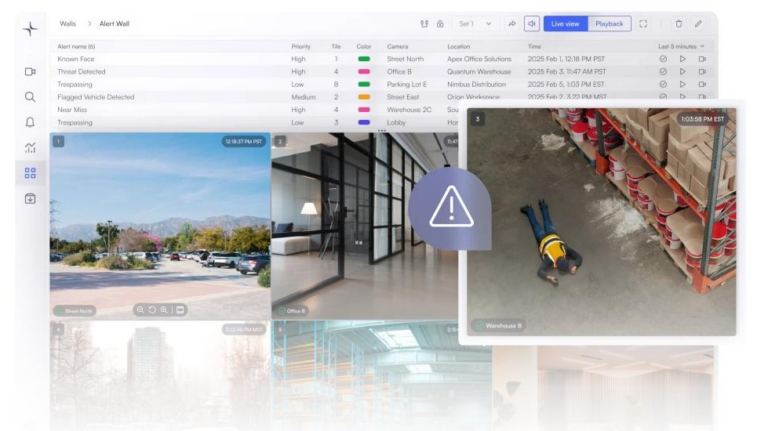
AI is transforming surveillance by helping operators focus on what matters rather than watching hours of live or recorded video. Instead of constantly monitoring dozens of camera feeds, edge AI can identify unusual activity and generate alerts only when predefined conditions are met, allowing security teams to respond more quickly and efficiently.
Because AI processing now takes place within the camera itself, organisations no longer need powerful servers to perform many analytics tasks. Cameras can classify objects such as people and vehicles, apply rules to identify abnormal behaviour and generate metadata that makes forensic investigations much faster. For example, operators can search for a person wearing a red top or a vehicle of a particular colour instead of manually reviewing hours of footage.
The real value of edge AI is that it filters out normal activity and highlights events that require attention. Whether it’s detecting someone crossing a virtual perimeter, identifying a vehicle travelling in the wrong direction or flagging a person remaining in an area longer than expected, AI acts as the operator’s first pair of eyes. It doesn’t replace human decision-making, but it enables security teams to work more proactively while significantly reducing the time spent searching video or monitoring uneventful scenes.
Anything else to note?
Selecting the right surveillance camera is no longer about choosing a single product that fits every application. From camera format and lens type to low-light performance, installation requirements and AI capabilities, every specification should support a clearly defined operational objective. By understanding the environment, identifying the risks and matching technology to the customer’s needs, installers can deliver systems that provide long-term value rather than simply meeting a specification. As surveillance technology continues to evolve, taking a consultative approach to camera selection will remain essential to building solutions that are both effective today and adaptable for the future.