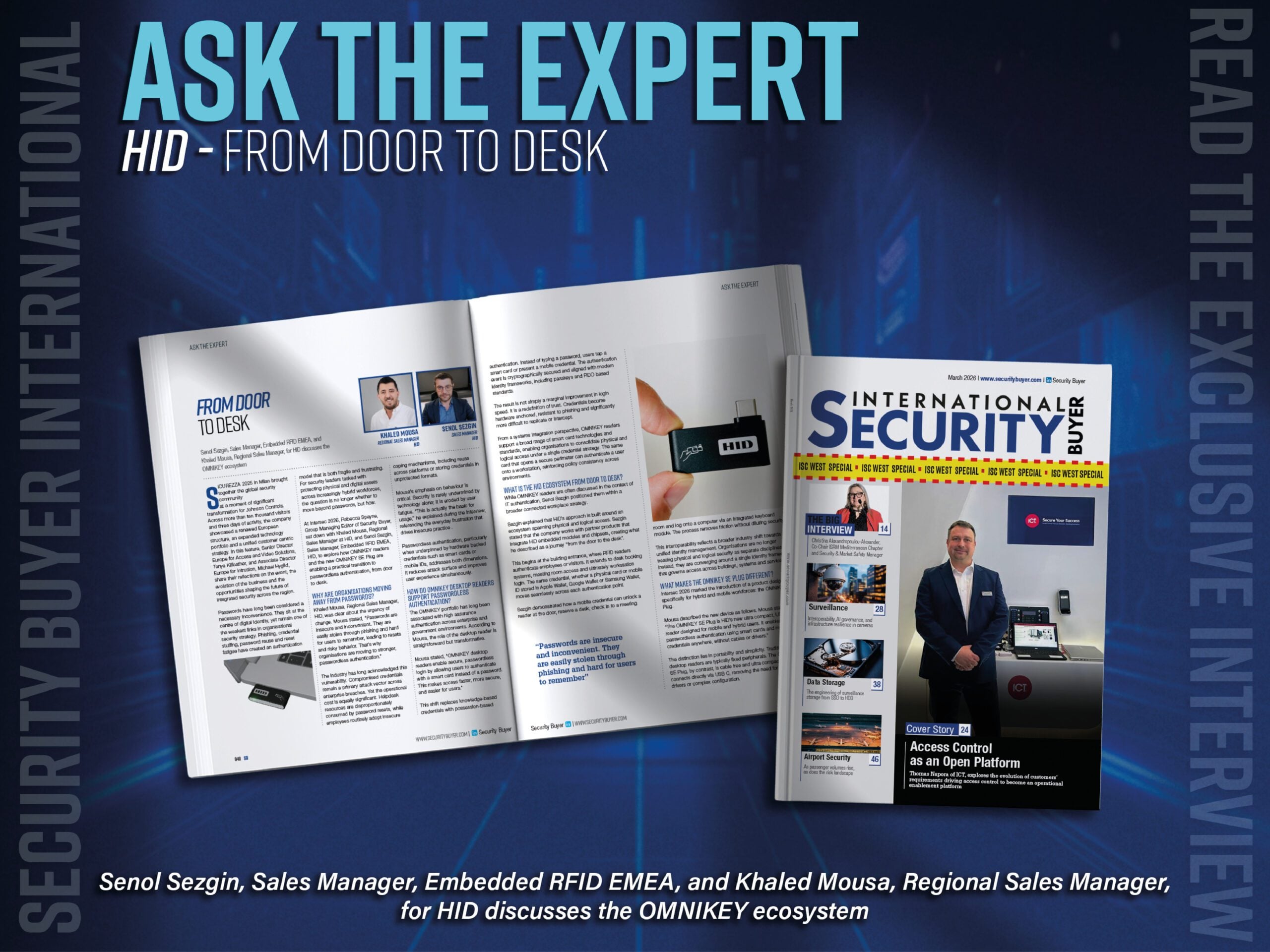

Senol Sezgin, Sales Manager, Embedded RFID EMEA, and Khaled Mousa, Regional Sales Manager, for HID discusses the OMNIKEY ecosystem
Passwords have long been considered a necessary inconvenience. They sit at the centre of digital identity, yet remain one of the weakest links in organisational security strategy. Phishing, credential stuffing, password reuse and reset fatigue have created an authentication model that is both fragile and frustrating. For security leaders tasked with protecting physical and digital assets across increasingly hybrid workforces, the question is no longer whether to move beyond passwords, but how.
At Intersec 2026, Rebecca Spayne, Group Managing Editor of Security Buyer, sat down with Khaled Mousa, Regional Sales Manager at HID, and Senol Sezgin, Sales Manager, Embedded RFID EMEA, HID, to explore how OMNIKEY readers and the new OMNIKEY SE Plug are enabling a practical transition to passwordless authentication, from door to desk.
Why are organisations moving away from passwords?
Khaled Mousa, Regional Sales Manager, HID, was clear about the urgency of change. Mousa stated, “Passwords are insecure and inconvenient. They are easily stolen through phishing and hard for users to remember, leading to resets and risky behavior. That’s why organisations are moving to stronger, passwordless authentication.”
The industry has long acknowledged this vulnerability. Compromised credentials remain a primary attack vector across enterprise breaches. Yet the operational cost is equally significant. Helpdesk resources are disproportionately consumed by password resets, while employees routinely adopt insecure coping mechanisms, including reuse across platforms or storing credentials in unprotected formats.
Mousa’s emphasis on behaviour is critical. Security is rarely undermined by technology alone; it is eroded by user fatigue. “This is actually the basic for usage,” he explained during the interview, referencing the everyday frustration that drives insecure practice .
Passwordless authentication, particularly when underpinned by hardware backed credentials such as smart cards or mobile IDs, addresses both dimensions. It reduces attack surface and improves user experience simultaneously.
How do OMNIKEY desktop readers support passwordless authentication?
The OMNIKEY portfolio has long been associated with high assurance authentication across enterprise and government environments. According to Mousa, the role of the desktop reader is straightforward but transformative.
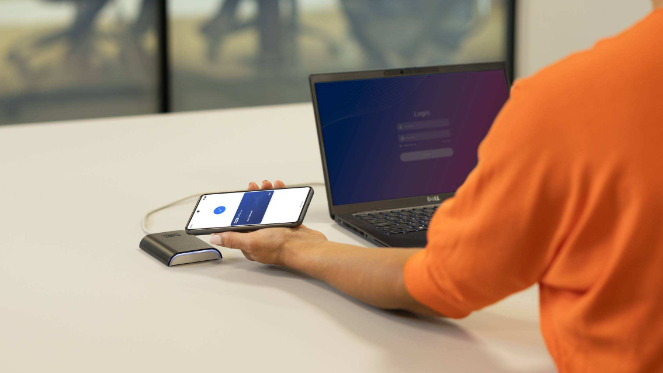
Mousa stated, “OMNIKEY desktop readers enable secure, passwordless login by allowing users to authenticate with a smart card instead of a password. This makes access faster, more secure, and easier for users.”
This shift replaces knowledge-based credentials with possession-based authentication. Instead of typing a password, users tap a smart card or present a mobile credential. The authentication event is cryptographically secured and aligned with modern identity frameworks, including passkeys and FIDO based standards.
The result is not simply a marginal improvement in login speed. It is a redefinition of trust. Credentials become hardware anchored, resistant to phishing and significantly more difficult to replicate or intercept.
From a systems integration perspective, OMNIKEY readers support a broad range of smart card technologies and standards, enabling organisations to consolidate physical and logical access under a single credential strategy. The same card that opens a secure perimeter can authenticate a user onto a workstation, reinforcing policy consistency across environments.
What is the HID ecosystem from door to desk?
While OMNIKEY readers are often discussed in the context of IT authentication, Senol Sezgin positioned them within a broader connected workplace strategy.
Sezgin explained that HID’s approach is built around an ecosystem spanning physical and logical access. Sezgin stated that the company works with partner products that integrate HID embedded modules and chipsets, creating what he described as a journey “from the door to the desk”.
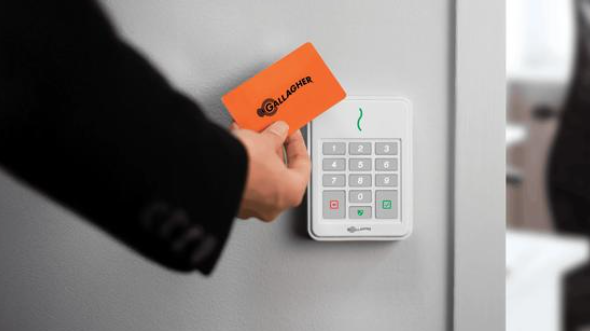
This begins at the building entrance, where RFID readers authenticate employees or visitors. It extends to desk booking systems, meeting room access and ultimately workstation login. The same credential, whether a physical card or mobile ID stored in Apple Wallet, Google Wallet or Samsung Wallet, moves seamlessly across each authentication point.
Sezgin demonstrated how a mobile credential can unlock a reader at the door, reserve a desk, check in to a meeting room and log onto a computer via an integrated keyboard module. The process removes friction without diluting security.
This interoperability reflects a broader industry shift towards unified identity management. Organisations are no longer treating physical and logical security as separate disciplines. Instead, they are converging around a single identity framework that governs access across buildings, systems and services….