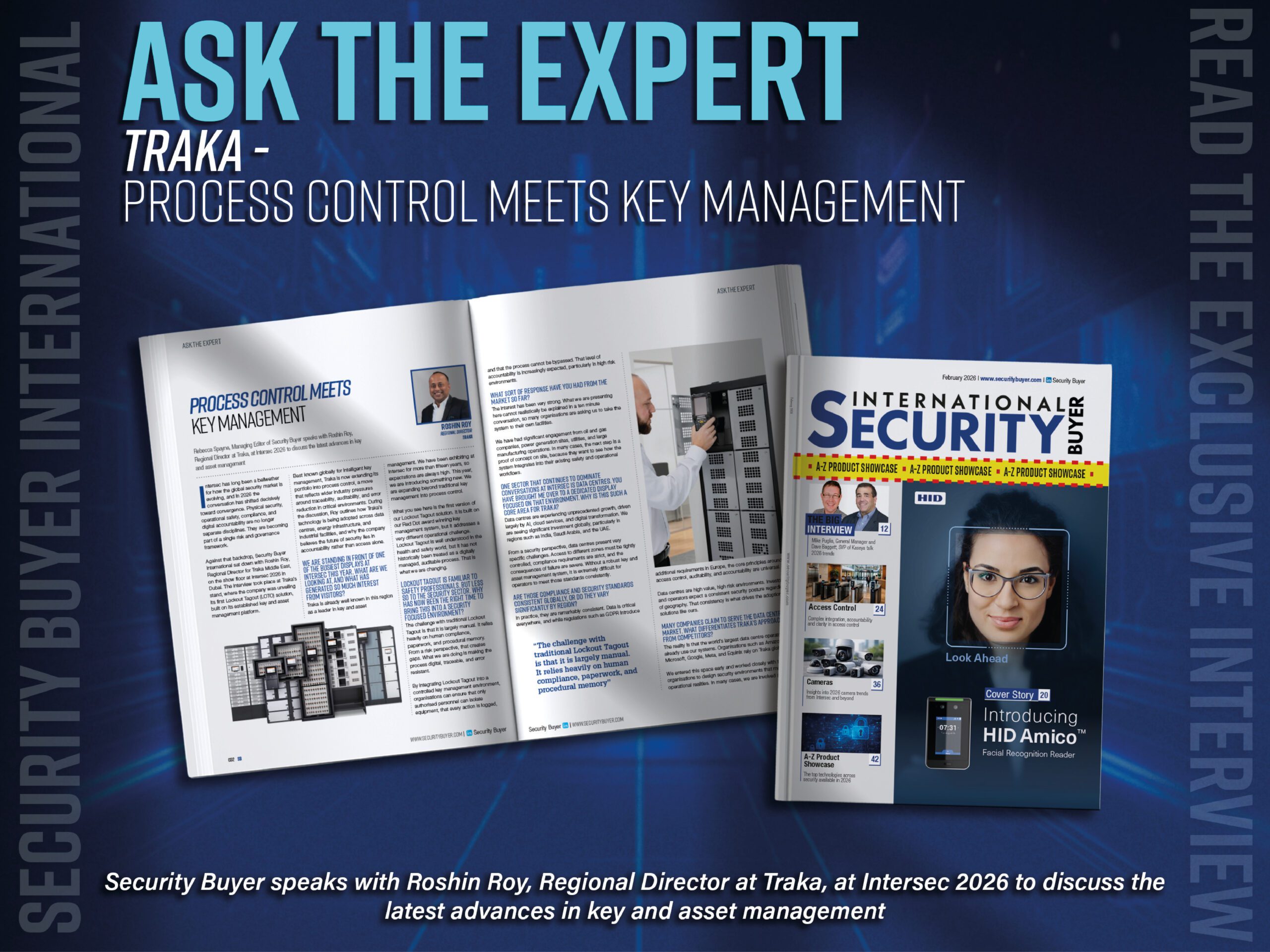

Rebecca Spayne, Managing Editor of Security Buyer speaks with Roshin Roy, Regional Director at Traka, at Intersec 2026 to discuss the latest advances in key and asset management
Intersec has long been a bellwether for how the global security market is evolving, and in 2026 the conversation has shifted decisively toward convergence. Physical security, operational safety, compliance, and digital accountability are no longer separate disciplines. They are becoming part of a single risk and governance framework.
Against that backdrop, Security Buyer International sat down with Roshin Roy, Regional Director for Traka Middle East, on the show floor at Intersec 2026 in Dubai. The interview took place at Traka’s stand, where the company was unveiling its first Lockout Tagout (LOTO) solution, built on its established key and asset management platform.
Best known globally for intelligent key management, Traka is now extending its portfolio into process control, a move that reflects wider industry pressures around traceability, auditability, and error reduction in critical environments. During the discussion, Roy outlines how Traka’s technology is being adopted across data centres, energy infrastructure, and industrial facilities, and why the company believes the future of security lies in accountability rather than access alone.
We are standing in front of one of the busiest displays at Intersec this year. What are we looking at, and what has generated so much interest from visitors?
Traka is already well known in this region as a leader in key and asset management. We have been exhibiting at Intersec for more than fifteen years, so expectations are always high. This year, we are introducing something new. We are expanding beyond traditional key management into process control.
What you see here is the first version of our Lockout Tagout solution. It is built on our Red Dot award winning key management system, but it addresses a very different operational challenge. Lockout Tagout is well understood in the health and safety world, but it has not historically been treated as a digitally managed, auditable process. That is what we are changing.
Lockout Tagout is familiar to safety professionals, but less so to the security sector. Why has now been the right time to bring this into a security focused environment?
The challenge with traditional Lockout Tagout is that it is largely manual. It relies heavily on human compliance, paperwork, and procedural memory. From a risk perspective, that creates gaps. What we are doing is making the process digital, traceable, and error resistant.
By integrating Lockout Tagout into a controlled key management environment, organisations can ensure that only authorised personnel can isolate equipment, that every action is logged, and that the process cannot be bypassed. That level of accountability is increasingly expected, particularly in high risk environments.
What sort of response have you had from the market so far?
The interest has been very strong. What we are presenting here cannot realistically be explained in a ten minute conversation, so many organisations are asking us to take the system to their own facilities.
We have had significant engagement from oil and gas companies, power generation sites, utilities, and large manufacturing operations. In many cases, the next step is a proof of concept on site, because they want to see how the system integrates into their existing safety and operational workflows.
One sector that continues to dominate conversations at Intersec is data centres. You have brought me over to a dedicated display focused on that environment. Why is this such a core area for Traka?
Data centres are experiencing unprecedented growth, driven largely by AI, cloud services, and digital transformation. We are seeing significant investment globally, particularly in regions such as India, Saudi Arabia, and the UAE.
From a security perspective, data centres present very specific challenges. Access to different zones must be tightly controlled, compliance requirements are strict, and the consequences of failure are severe. Without a robust key and asset management system, it is extremely difficult for operators to meet those standards consistently…
Read the full interview here

Watch the video here