

The Security Event Birmingham, one of the largest UK shows in the industry takes place in May. Security Buyer explores what we can expect from the show
Trade shows tend to present a version of the industry that is cleaner than reality. Systems work seamlessly, integrations are implied rather than demonstrated, and complexity is often hidden behind well-designed stands.
What makes The Security Event at the NEC in Birmingham worth paying attention to is not the scale or the numbers attached to it, but the timing. The industry is entering a phase where technology is no longer being judged on what it promises, but on how it performs once deployed. That changes the tone of the exhibition floor entirely.
Across three days in May, more than 450 exhibitors will present over 10,000 products and solutions spanning video surveillance, access control, intrusion detection, and integrated platforms. The volume is not unusual. What is changing is how those products are being positioned.
The emphasis is shifting from capability to application.
From Product to Platform
One of the more consistent themes emerging from exhibitor activity is the continued move away from standalone devices towards platform-based approaches.
This is not new, but it is becoming more defined. Where previous years focused on integration as an ambition, current exhibitor messaging suggests that integration is now expected as a baseline. The conversation has moved from whether systems can connect, to whether those connections produce anything meaningful.
Exhibitors such as Ajax Systems and Alarm.com are expected to continue developing this platform approach, where intrusion detection, video, and user interaction are managed within a single environment. The technical challenge is not simply connecting devices, but ensuring that those connections reduce operational friction rather than add to it.
Cloud-native and hybrid architectures remain central to this shift. However, the balance between cloud and edge processing is still unresolved. Bandwidth, latency, and data sovereignty continue to influence how systems are deployed, particularly in multi-site environments.
What is likely to be evident across the show floor is that there is no universal model. Architecture is becoming use-case driven rather than vendor-driven.
Detection Is No Longer Enough
Intrusion systems remain a core part of the exhibition, but their role is changing. Historically, alarm systems were designed to detect an event and escalate it. That model still exists, but it is increasingly being supplemented by verification layers and workflow integration.
Exhibitor developments in this space are focusing on reducing false alarms and improving response accuracy. This includes the integration of video verification, enhanced sensor technology, and more refined signal processing.
Recent exhibitor news highlights this direction. OPTEX, for example, has introduced LiDAR-based sensing designed for precise, short-range detection in high-security environments . The relevance of this is not just in detection accuracy, but in the ability to define detection zones more precisely, reducing unnecessary triggers.
Similarly, developments in communication technology are addressing a different part of the problem. The introduction of systems designed to manage both legacy and modern infrastructure through a single interface reflects the reality that many organisations are operating hybrid environments.
The implication is straightforward. Detection is no longer the endpoint. It is the beginning of a process that must include verification, interpretation, and response.
Video as a Data Source, Not a Recording Tool
Video surveillance continues to dominate floor space at any security exhibition, but its role is changing in a way that is less visible.
The shift is not about image quality or resolution, although those continue to improve incrementally. It is about how video is used once captured.
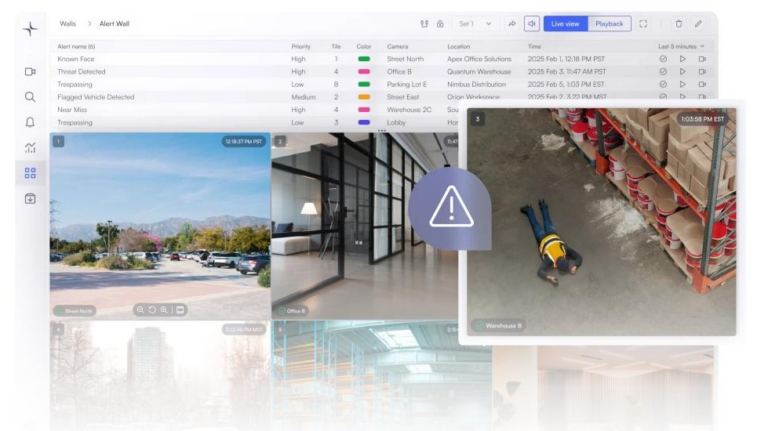
Exhibitors such as OpenEye and others within the video ecosystem are focusing on searchability, metadata, and integration with other systems. The ability to locate specific events quickly, whether for real-time response or post-incident analysis, is becoming more important than the ability to capture footage in the first place.
This aligns with a broader trend towards treating video as structured data rather than unstructured content. Analytics, indexing, and tagging are enabling systems to move away from manual review towards automated interpretation.
However, this introduces its own challenges. Increased data volume places pressure on storage and retrieval systems, while analytics must be refined to avoid generating excessive or irrelevant alerts.
The industry appears to be moving towards a more measured application of analytics, focusing on relevance rather than quantity.